What Is Turtle Trading? Commodity Strategy Guide



Turtle trading was one of the first experiments conducted to show whether systematic trading can be profitable. It was conducted by Richard Dennis and William Eckhardt. While trading requires a good knack for picking stocks, Dennis strongly believed that a trader can be trained. To test his hypothesis, he hired many ordinary people new to trading. These were called turtles. Then they were given extensive training for a few weeks and, finally, real trading capital to trade.
According to some references, the turtles generated massive profits using a simple rule-based system. Also, most of this was done on the commodity futures market.
Why Turtle Trading Focused on Commodities
Before going into the strategy itself, it is important to understand why Dennis favoured commodities over other asset classes, such as equities. They had chosen commodities futures because of these reasons:
- Futures provide leverage: Futures are leveraged products that can help amplify the profits made by the turtles.
- Liquidity was sufficient: The commodity future markets had good liquidity which resulted in lower slippage costs
- Strong trending behaviour is common: Commodity futures are known to have strong trends.
- Supply-demand shocks produce extended moves: often, prices are driven by supply-demand imbalances, which can lead to extended movements.
Also check : Scalper Mode on 915 | Straddle Chart
Core Principle: Trend Following via Breakouts
Dennis was a firm believer in trend-following and developed a system based on a breakout model. The basic rule was that the turtles would:
- Buy, if the price breaks the resistance band
- Sell (short) if the price breaks the support band.
The important thing was that there were no predictions, forecasts, or discretionary filters. The same rules applied to all traders, and the system was designed to react to prices. The system simply reacted to price.
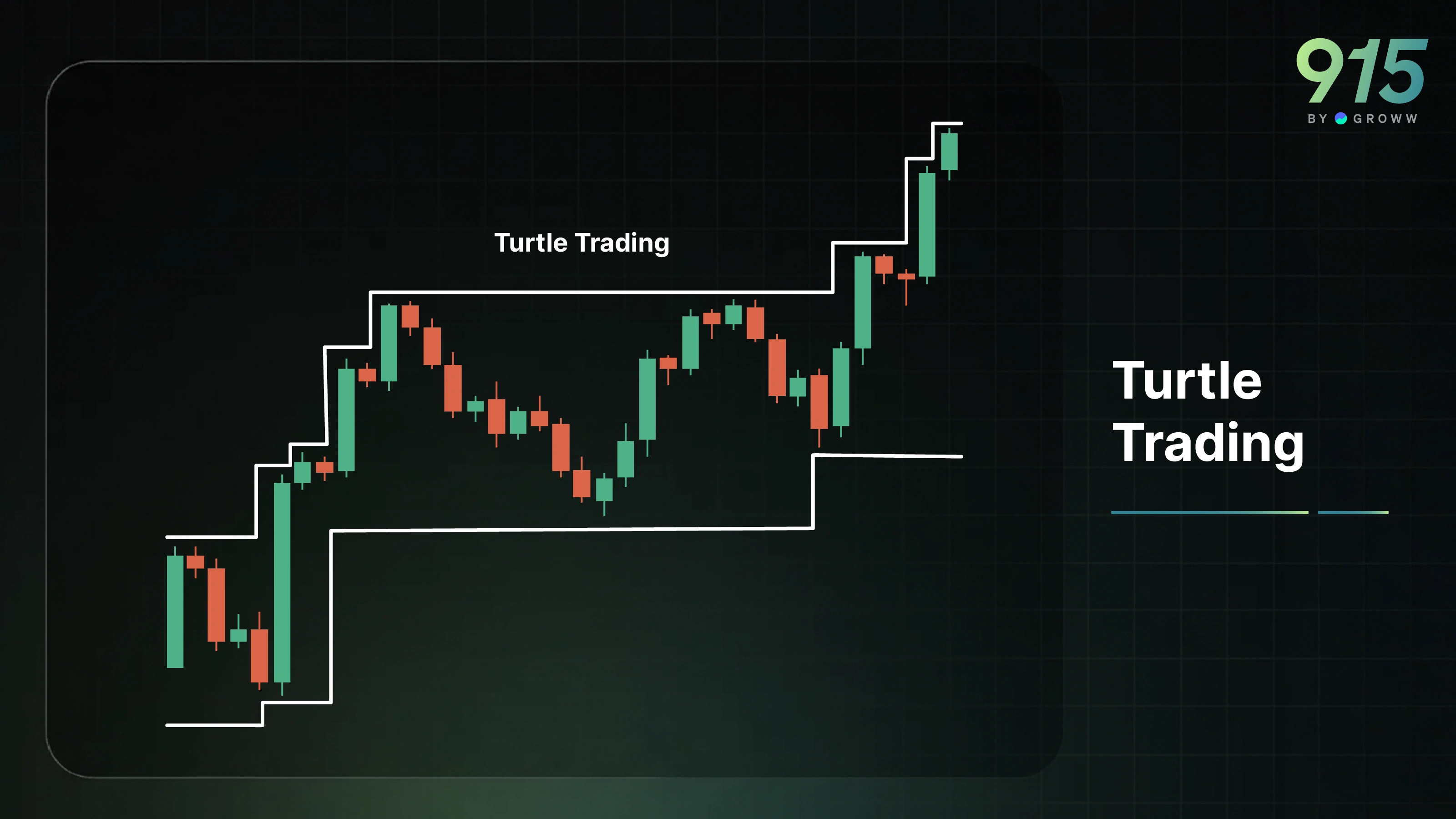
Dennis used a simple Donchian channel breakout to get the entry signal. They used multiple breakout windows to filter the traders. For short-term trades, the entry was made when the price broke the 20-day Donchian channel. On the other hand, for long-term trades, the entry was made when the price broke the 55-day Donchian channel.
For example:
- If the price moves above the past 20-day high, the traders will go for a long entry
- If the price moves below the past 20-day low, the traders will go for a short entry.
As per the references, system 2 was used if system 1 had missed the move or been stopped out.
The Turtle Exit System
Dennis believed in simplicity. The exits were again based solely on the Donchian channel. For exits, the 10-day Donchian channel was used. So for long trades, the stoploss was when the price closed below the 10-day low Donchian channel.
And for the short trades, the stoploss was when the price closed above the 10-day high Donchian channel. This allowed traders to stay with trends until the market structure actually broke.
Position Sizing Using Volatility (ATR-Based)
Position sizing was a critical edge of the Turtle system. Turtle traders used the concept of ATR and volatility-adjusted units. The idea was to allocate fewer contracts to volatile markets and more to stable markets. This was done because every commodity has different volatility. To normalise risk across commodities, ATR was used, which worked in their favour.
Turtle traders also believed in pyramiding. They would actively add more quantities to winning trades. For example, the original trade started with “N” quantity (depending on ATR). Now, the traders would add 0.5N when the move was in their favour. The maximum allowed units were 4N. This allowed large trends to become massive winners, while losers were kept small.
Risk Management and Maximum Exposure
As with all good trading systems, Dennis’s trading system also had very controlled risk measures. Traders were advised to keep the risk per trade around 1% of the equity curve. There were other risk measures, such as the maximum exposure per market and maximum exposure per correlated group (e.g., metals, grains). This prevented catastrophic losses during commodity shocks.
Common Criticisms and Reality
It has been documented that turtle traders made a good profit. But are these profits possible now? Some traders criticise Turtle concepts on two grounds:
- Markets are more efficient now
- Breakouts fail more frequently today
It is largely true that a simple system like donchian channel might not work now. However, the essence of the complete system is more important. Dennis and his turtles were consistently profitable because they followed a comprehensive system that included entry, exit, position sizing, volatility, and even pyramiding.
Traders can use the same concepts and adapt them to the current environment, which features faster markets, more liquidity, and tighter spreads. The adapted version for modern traders can include using the below, along with Dennis original rules:
- Multiple timeframe filters: Modern traders can perform multiple time-frame analyses to better understand a symbol's trend.
- Trend filters (e.g., price vs. moving average): Some basic indicators, such as Moving Averages, can provide double confirmation that the trend is intact or that the asset is overextended.
- Volatility regime filters: While ATR is a good volatility measure, RSI can now be used to identify overbought and oversold regions.
- Adaptive exits: The exits can be more specific and leverage features like swing lows.
The philosophy remains unchanged: Trade trends with discipline, size positions by volatility, cut losses quickly, and let winners run.
Conclusion
Turtle Trading was a breakthrough experiment that showed that ordinary traders can be profitable if they have a good mentor and a good trading system. The turtles were successful in trading commodity futures because they had a structured system with clear breakout entries. The position sizing was based on volatility, and they believed in using trailing stoplosses. The brilliance of the Turtle approach was not in the system's complexity, but in the consistency of its execution.