What is Reinvestment Risk? Meaning, Examples & Mitigation Strategies


If you’re relying on fixed-income portfolios, picture a situation where your purchasing power steadily erodes during falling-rate cycles after retirement. So, you’ll have two options in your sunset years- find new ways to earn new income (which is tough) or shrink your lifestyle. This silent threat to every portfolio comes from what we call reinvestment risk.
Reinvestment risk is the risk that an investor will earn lower returns if he or she reinvests interest payments received periodically or matured principal (that is, the return on the investment). This risk is triggered immediately in the Indian domestic market whenever the RBI (Reserve Bank of India) switches to a lower interest-rate environment. This forces savers to renew their fixed deposits or buy new bonds at lower yields. It hits FDs (Fixed Deposits), monthly income schemes (MIS), and Government or corporate bonds the hardest, which are hugely popular among Indian investors, households, and retirees.
Let us learn more about reinvestment risk, how it works, yield to maturity (YTM) and some examples, along with instruments with lower reinvestment risk in India, among other aspects.
Key Takeaways
- Reinvestment risk refers to the risk of being unable to reinvest cash flows like periodic interest payouts, matured principal or bond coupons at the same rate as the original investment.
- It mainly occurs when the RBI shifts to a lower interest-rate regime, forcing people to invest at lower yields. It has the biggest effect on Fixed Deposits (FDs), MIS (monthly income schemes) and corporate/Government bonds.
- Bond laddering is often a good way to stagger maturities across years; you don't have to roll over the whole corpus at a single low-rate threshold.
- Cumulative deposit/growth options (interest compounds internally) are also good options, along with diversifying into longer-duration fixed instruments or alternative asset classes.
What is Reinvestment Risk?
Reinvestment risk is the likelihood that an investor will receive lower returns when they reinvest periodic interest payouts or matured principal (investment returns) back into the market. Hence, it is the risk of failing to redeploy investment returns into new investments at rates as high as the original investment.
This heavily affects anyone who depends on fixed-income assets in the Indian market. These include fixed deposits (FDs), corporate or Government bonds, and debt mutual funds. This happens whenever the Reserve Bank of India (RBI) cuts its interest rates.
How Reinvestment Risk Works
Here is a guide to how reinvestment risk works:
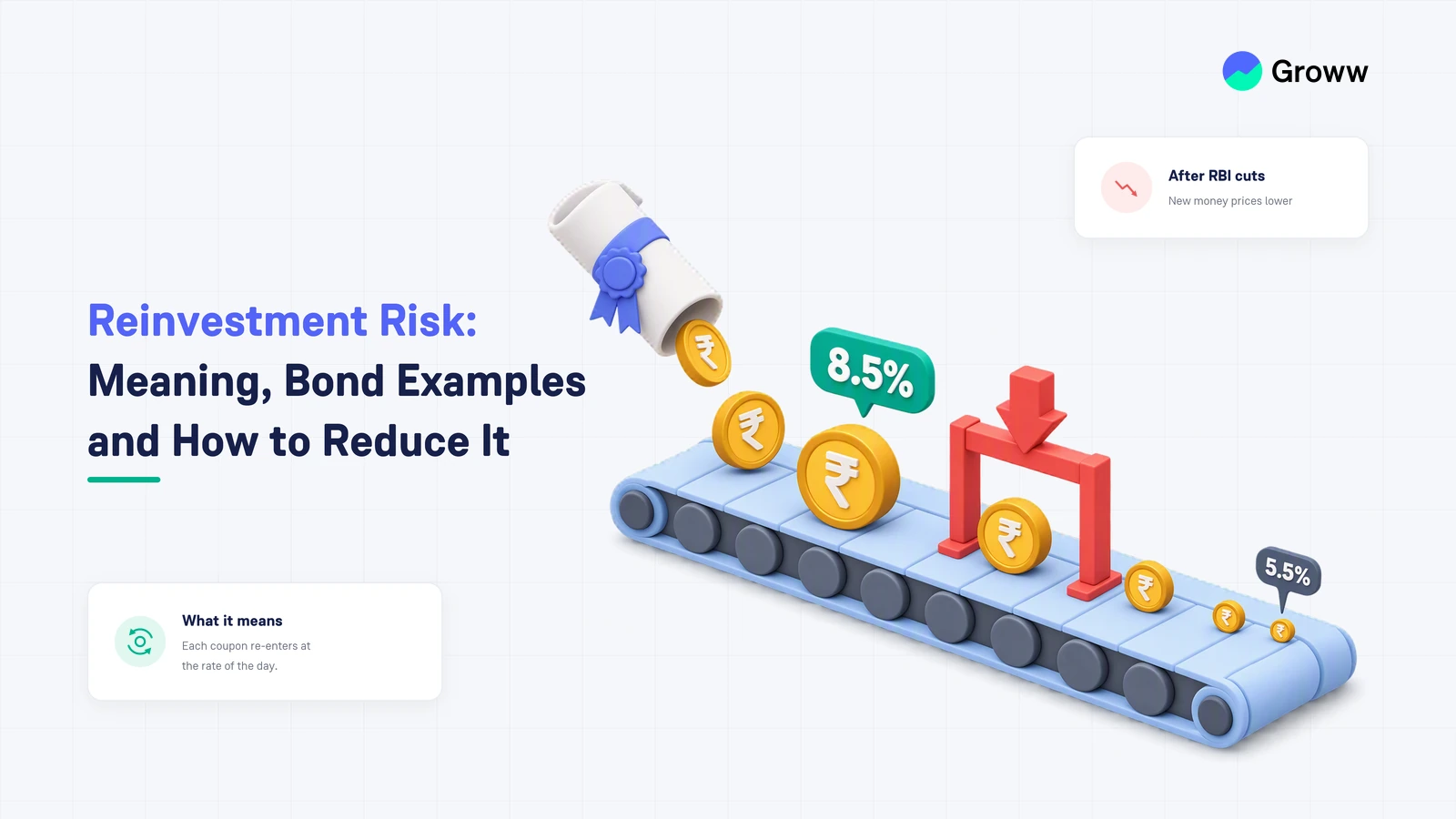
- Falling Rate Cycle: The immediate trigger for reinvestment risk is naturally a falling rate cycle, after any such move by the RBI. Suppose you lock in a corporate bond or fixed deposit at 8.5% per annum initially, but the market interest rates slide down considerably to 5.5% by the time your maturity or payout comes. Hence, your new reinvestment options will yield considerably lower returns.
- Periodic Payouts: Regular coupon-paying bonds (Government Securities) or non-cumulative fixed deposits (FDs) may force investors to manage frequent cash inflows that suffer in falling-rate environments.
Here’s how reinvestment risk works for various financial products or investments in India:
- Fixed Deposits (FDs): Suppose you lock in a three-year bank FD at about 7% per annum, receiving regular payouts or a lump sum at maturity. If the RBI reduces interest rates during those three years, renewing the FD at maturity may only get you 6%. So the principal will be safe, but your future interest earnings will drop.
- Periodic Payouts (Non-Cumulative FDs/Bonds): Non-cumulative options will send quarterly or monthly interest to the savings account. Now, each small payment has to be redeployed separately for reinvestment. If rates fall, each payout will earn a lower return on its own.
- Debt Mutual Funds: Dynamic bond funds (actively managed debt mutual funds that change their portfolio tenures and maturities based on interest rate shifts) and income funds (funds focused on cash generation over long-term growth) face this scenario when the underlying Government or corporate bond matures. The fund manager must purchase new bonds at lower current market yields. This lowers the overall growth return or dividend for the investors.
Reinvestment Risk and Yield to Maturity (YTM)
YTM (Yield to Maturity) assumes an investor reinvests all periodic coupon payments at the same YTM rate until the bond matures. Reinvestment risk, by contrast, is the risk that future coupon payments cannot be reinvested at the same high rate as the original investment (if market interest rates fall).
In this case, YTM is the total annualised return on a bond held to maturity, accounting for the face value, coupon payments, and current market price. Investors reinvest every cash flow (annual or semi-annual) received during the bond's life at the original YTM.
If market conditions change, the actual realised return will differ from the YTM quoted initially. So, if you factor reinvestment risk into the equation, investors must reinvest these periodic payouts at lower rates.
As a result, the actual realised return will naturally fall short of the initial YTM. Suppose you purchase a Government or corporate bond with a YTM of 7.5%. In this case, the calculation will plug each semi-annual or annual interest payout back in at 7.5% immediately.
However, if the RBI cuts the repo rate during the holding period, the market yield will fall. The interest payout you get will be impossible to reinvest at the original YTM of 7.5%. Thus, your realised or actual return over the life of the bond will be lower than the YTM quoted at the time of purchase.
Alternatively, if rates rise, the realised return may surpass the initial YTM. Understanding realised compound yield (or horizon yield) is also important in this case. It is the actual annualised interest rate of return that is earned on a bond over a particular investment timeframe. It accounts for the actual reinvestment rates of interim coupon payments and any sale price.
Examples
As you know, reinvestment risk is the chance of earning less money when you redeploy your paid-out principal or investment earnings, and it happens when market rates come down.
Here are some examples of reinvestment risk in India.
- Fixed Deposit Reinvestment Risk:
Let us take a brief calculation here:
-
- Initial investment: ₹10 lakh (3-year FD) at 7.5% (annual interest).
- Initial annual interest payout: ₹75,000.
- New market rate: 5.5%.
- Reinvestment Loss: ₹20,000 per year (₹60,000 over 3 years).
- Corporate Bonds:
Suppose you invest in a corporate bond from a reputed Indian entity that pays a yearly coupon (interest) of 9% on an investment of ₹5 lakh. As a result, you will receive ₹45,000 annually.
After two years, RBI (Reserve Bank of India) rate cuts will bring market yields down accordingly. When this ₹45,000 comes in, and you reinvest it into a new debenture or secure bond, the available rate will be just 6.5%. Hence, your future cash flow will decrease.
Which Investments Carry the Most Reinvestment Risk?
There are several investments that carry some of the highest reinvestment risk, including the following:
- Long-Term Government Securities (G-Secs) and Gilt Funds: If you are locked into long-term sovereign paper, it may have sizeable reinvestment risks. If the market interest rates fall by the time your maturity proceeds or coupons arrive, you may be able to purchase new bonds only at lower yields.
- Non-Cumulative Bank and Corporate Fixed Deposits: High-tenure fixed deposits (FDs) booked during high-interest-rate cycles may expose you to high reinvestment risk at maturity. This may happen if the Reserve Bank of India (RBI) lowers rates during the interim period.
- Non-Convertible Debentures (NCDs) and Corporate Bonds: Periodic interest payout (payout-option) NCDs will require you to discover alternative instruments for cash flows. This can bring lower yields in a softening rate environment.
- Short-Term Debt and Overnight Funds: Since they constantly roll over at the present short-term rates, they can transparently capture the rate environment. This is done without large and multi-year locking discrepancies. However, there is always a risk of lower yields upon reinvesting.
Instruments with Low Reinvestment Risk:
Here are some instruments that have lower reinvestment risks:
- Floating Rate Savings Bonds: Some instruments, such as the RBI Floating Rate Savings Bonds, dynamically tweak their payouts with changing market benchmarks. This safeguards investors from sharper rate drops.
- Equity Stocks and Mutual Funds: Equities are mainly driven by inflation and business earnings, instead of fixed coupons. This means that they do not have traditional cash-flow reinvestment risks.
- Zero-Coupon Bonds: They have zero reinvestment risk because they do not pay periodic interest during their tenure. They are usually purchased at deep discounts to face value, and investors receive one lump-sum payout at maturity. Because there is no intermediate cash flow to reinvest, it is a classic example of a zero-reinvestment-risk instrument.
|
Instrument |
Risk Level |
Reason |
|
Zero-Coupon Bonds |
Lowest (Zero/Negligible) |
They do not pay any periodic interest or have interim cash flows |
|
Floating Rate Savings Bonds |
Low |
Interest rates reset periodically, tracking benchmark rates. Payouts automatically adjust with market rates |
|
Equity Stocks and Mutual Funds |
Moderate/variable |
No guaranteed fixed income or predictable coupon cash flows. Only dividends face minor reinvestment pressure |
|
Overnight and Short-Term Debt Funds |
Highest |
Portfolios mature and roll over continuously (one day to one year). If market rates fall, then incoming cash has to be reinvested into lower-yield assets |
|
Non-Cumulative Bank and Corporate FDs |
High |
Interest is paid out periodically and if interest rates fall, it leads to reinvestment risks |
|
NCDs and Corporate Bonds |
High |
High-frequency payouts need continuous reinvestment |
|
Long-Term Government Securities and Gilt Funds |
High |
Periodic semi-annual or annual coupons over a longer period. Prolonged falling rates reduce the cumulative earnings from reinvested coupon flows. |
Factors that Scale Reinvestment Risks in India:
- High Coupon Bonds: Bonds or NCDs (non-convertible debentures) that provide regular, high payouts have higher reinvestment risk. This is because a large part of the overall lifetime return depends on successfully reinvesting large cash flows.
- Debt Mutual Funds: For mutual fund investors in India, the disclosed YTM of a portfolio is an overview of its present earning potential. It is not a guaranteed return. If the interest rate cycle falls, the fund's future rolling yield drops accordingly.
- Callable Bonds: Corporate bonds with call options in India are highly exposed; issuers usually call back high-yielding bonds whenever market interest rates fall. This may force investors to reinvest at the worst possible time, when the yields are on the lower side. The key point is that issuers will almost always call their bonds to refinance at a lower cost when interest rates fall. So, callable bonds make investors more vulnerable to significant reinvestment risk. When the issuer exercises call options, the investor's high-interest payments end early. This leaves you with cash that you cannot deploy at the same competitive rates.
Reinvestment Risk vs. Interest Rate Risk
Here is a thorough comparison of reinvestment risk vs. interest rate risk.
|
Key Aspect |
Interest Rate Risk (Price Risk) |
Reinvestment Risk |
|
Meaning |
Fall in existing bond market value owing to rising yields in the market |
Unable to reinvest cash flows/coupon payouts at the earlier high rates |
|
Trigger Market Condition |
Rises with an increase in the market interest rates |
Rises when the market interest rates go down |
|
Portfolio Effect |
Capital loss in case of a sale before maturity; the NAV (net asset value) of the debt funds comes down |
Lower income in the future and reduced overall realised YTM (yield-to-maturity) |
|
Example of Financial Instruments |
Long-duration Government bonds or 10-year Gilt (funds investing at least 80% in Government securities) funds when the repo rates are increased by the RBI |
Cumulative fixed deposits maturing in low-rate cycles or high-coupon corporate non-convertible debentures (NCDs), while paying periodic interest |
|
Who Faces the Situation |
Investors who have to liquidate their fixed-income assets prior to maturity |
Income-seekers, institutional funds and retirees who depend on periodic payouts of interest |
|
Mitigation Measures |
Holding gilts or bonds till maturity and choosing shorter-duration debt funds or liquid funds |
Using target maturity funds, bond laddering or zero-coupon bonds |
How to Reduce Reinvestment Risk
There are several ways to lower reinvestment risk as an investor. Some of them include:
- Cumulative FDs: Rather than regular quarterly or monthly payout options for corporate or bank FDs (fixed deposits), you should choose cumulative fixed deposits instead.In these cases, the interest compounds internally within the deposit and can only be paid out at maturity. This prevents any intermediate cash flow or payout from hitting your account during a falling-rate cycle.
- Execute FD or Bond Laddering: You may split your lump sum into various parts across different tenures, i.e., 1, 2, 3, 4, 5, and more years.With each portion maturing sequentially, you can average out interest-rate cycles. This prevents exposing your entire corpus to one low-rate window.
- Choose the Growth Option for Mutual Funds: For hybrid or debt mutual funds, avoid income distribution cum capital withdrawal (IDCW) plans.Choose the Growth mode to ensure your gains compound internally, without taxable and periodic cash payouts that require fresh reinvestment.
- Using Government Small Savings Schemes: You may lock your funds for longer tenures in Government-supported instruments, such as the Senior Citizens Savings Scheme (SCSS) or the Public Provident Fund (PPF). They may offer more regulated, attractive rates that are often protected from immediate market downturns.
- Locking in Long-Term Corporate Bonds or G-Secs: You may consider buying high-quality, long-duration, non-callable corporate bonds or sovereign Government securities (G-Secs).
This may be a good move when interest rates hit a peak, allowing you to lock in higher yields for an extended period.
Conclusion
Reinvestment risk is a quiet yet important danger, in particular for Indian investors who depend a great deal on fixed-income products such as fixed deposits, bonds, and debt mutual funds to obtain a regular income.
When the Reserve Bank of India alters its interest rate cycles, the returns you previously secured at attractive rates might no longer be available when your income payments or the original principal amount come due.
It is essential to understand the way reinvestment risk relates to yield to maturity and to recognise which types of investments have a higher or lower level of exposure to this risk.
You can effectively protect your portfolio from declining interest rates by using strategies such as bond laddering, cumulative fixed deposits, growth-option mutual funds, zero-coupon bonds, and long-duration G-Secs.