What Are Inflation-Indexed Bonds? How They Work and Protect Purchasing Power
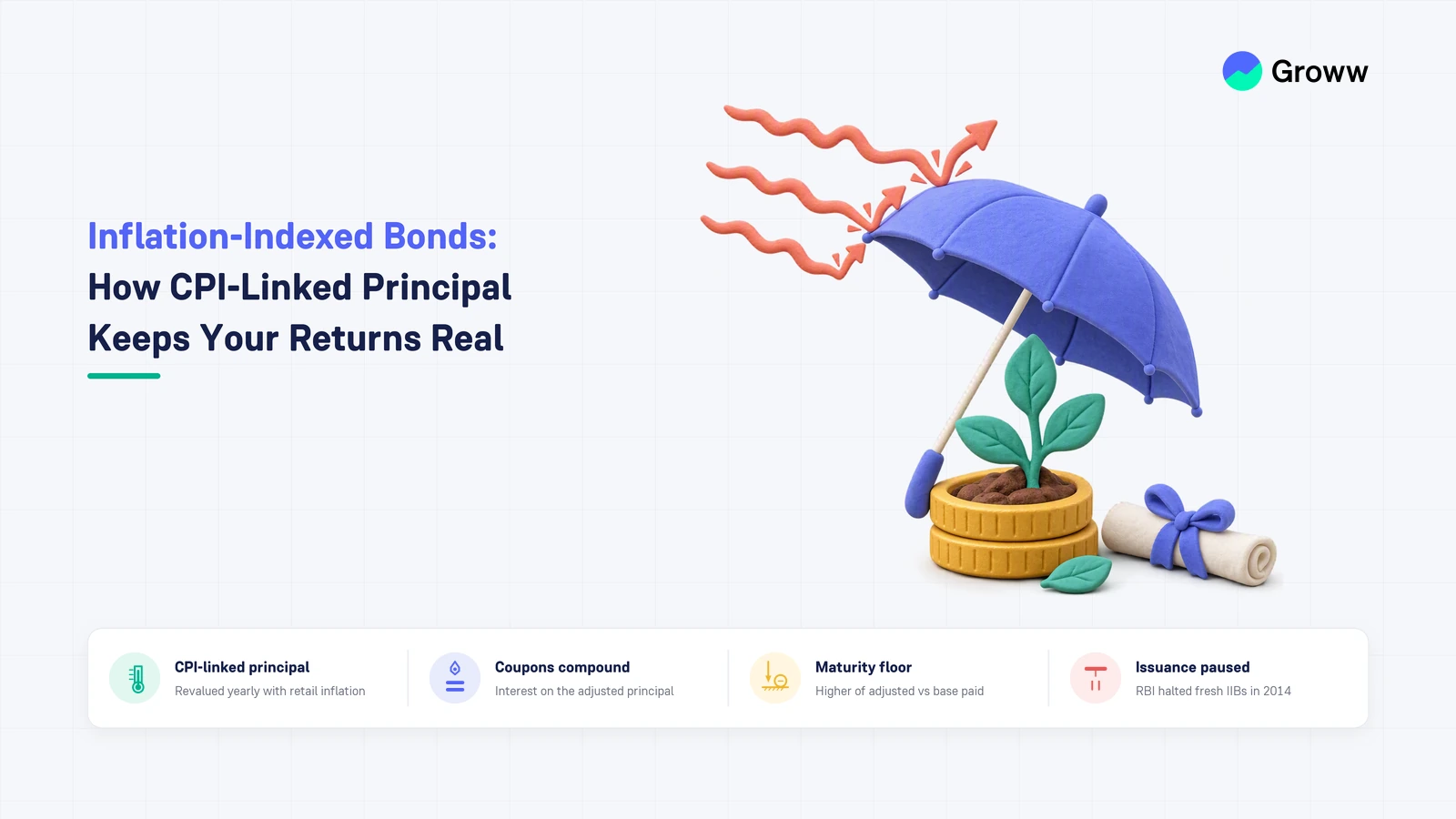


Inflation-indexed bonds (IIBs) were Government of India securities whose principal and interest payments adjusted with inflation to preserve real returns.
The Reserve Bank of India (RBI) halted fresh issuance of IIBs in 2014, after their extended subscription period closed on 31 March. This was mainly due to structural and macroeconomic factors, along with muted demand.
When available, IIBs were specialised Government securities designed to safeguard investors against future inflation. They adjusted both principal and interest payments based on price indices, so the investment was designed to help preserve purchasing power.
Key Takeaways
- Inflation-indexed bonds (IIBs) are sovereign debt securities designed to protect investors' principal and interest from inflation. They are linked to the CPI (Consumer Price Index), adjusting principal values upward in sync with rising inflation (instead of the Wholesale Price Index, or WPI).
- The goal is to preserve real purchasing power. In this case, both the principal amount and coupon interest dynamically scale up with inflation adjustments.
- Periodic interest payouts will apply to the newly inflated and adjusted principal instead of the face value, which otherwise remains static (compounding effect).
- The Government halted issuance after 2014 because of lower retail appetite for IIBs, along with more complex structures and lower secondary-market trading depth.
What are Inflation-Indexed Bonds (IIBs)?
Inflation-indexed bonds, or IIBs, are government securities issued by the RBI. Here, both the principal amount invested and the interest payouts are dynamically adjusted in line with inflation. IIBs are linked to the CPI (Consumer Price Index) and protect the real purchasing power of investor savings from rising consumer prices.
Hence, the face value of the bond goes up/down depending on the changes in the inflation index. Fixed coupon rates also apply to the inflation-adjusted principal instead of the initial face value.
As a result, absolute returns could be higher for investors during periods of high inflation. Investors received the original face value or the final adjusted principal (whichever was higher) upon redemption.
They were previously transitioned from the Wholesale Price Index (WPI) to the CPI (Consumer Price Index, combined). This was done to reflect retail price changes more accurately. Unlike the capital-indexed bonds of 1997, which only safeguarded the principal, IIBs protect both interest and principal payments.
Also, since they were backed by the Government, they were eligible for regulatory aspects like the SLR (statutory liquidity ratio) for commercial banks.
How Do Inflation-Indexed Bonds Work?
How do inflation-indexed bonds actually work? They are Government securities that safeguard investors' capital and returns from inflation. Here is how the entire system functions:
- Making the Investment: The investor purchases the bond at its face value. A fixed real coupon rate will also be outlined at this time.
- Inflation Adjustments: The principal amount invested will increase or decrease regularly based on changes in the retail CPI (Consumer Price Index) inflation rate.
- Interest Payments: Regular interest (semi-annual basis) will be calculated based on the newly adjusted and higher principal amount. It will not be calculated on the original investment or face value.
- Redemption or Maturity: When the term concludes, the investor will receive the final payment, which will be the greater of the inflation-adjusted principal amount or the initial face value. This adds a layer of safety to the investment, even if deflation occurs instead of inflation.
Example:
IIBs worked on a simple principle: the bond’s principal amount and coupon payments were directly linked to the CPI (retail inflation index). Instead of changing the fixed percentage interest rate (real coupon rate), the bond's face value was adjusted daily/monthly based on price movements.
For this adjustment, the RBI introduced a multiplier known as the Index Ratio (IR). Its formula is: IR = Current CPI (CPI value for the current period, sometimes with a 3-month lag) / Reference CPI (CPI value at the time the bond is issued).
Cash Flow Calculation:
- Adjusted Principal = Base Principal x Index Ratio
- Coupon Payment = Adjusted Principal x Real Coupon Rate
- Maturity: You will get the final Adjusted Principal or the original base principal, whichever is higher.
Mathematical Example:
- Base Principal/Initial Investment: ₹20,000
- Fixed Real Coupon Rate: 1.5% per annum
- Initial Reference CPI: 100
- Assumed Inflation Profile: Year 1: 5%, Year 2: 6%, Year 3: 4%
Since the principal updates at each evaluation interval, the interest payout will have a specific compounding effect. Here is how it is worked out:
|
Year |
CPI Inflation Rate |
Adjusted Principal & Coupon Paid |
|
1 |
5% |
Adjusted Principal: ₹21,000.00 (Index Ratio: 1.05) |
|
2 |
6% |
• Adjusted Principal: ₹22,260.00 (Index Ratio: 1.113) |
|
3 |
4% |
Adjusted Principal: ₹23,150.40 (Index Ratio: 1.1575) |
This is how the compounding effect works: the 6% inflation in Year 2 accumulates on top of the already adjusted principal in Year 1. This improves both immediate cash flow and total asset value.
Note: IIBs do not have any special tax exemptions. They will be taxed based on the income tax slab, just like regular debt securities. They also qualify for the SLR (statutory liquidity ratio) requirements at commercial banks, as mentioned earlier.
Benefits of Inflation-Indexed Bonds
Investing in inflation-indexed bonds offers several advantages. The RBI issues these sovereign securities, backed by the Government. Here is a snapshot of their core benefits:
- Safety from Inflation: The nominal principal amount invested increases with inflation. This was designed to offset higher prices that would otherwise eat into the investment's real value.
- Higher Payouts: Periodic interest is calculated based on the updated principal amount adjusted for inflation. This system, in place of the original face value, may enable higher payouts for investors.
- Sovereign Guarantee: These investments carry no credit risk; they are sovereign debt securities backed by the Government of India.
- Maturity Principal Floor: At maturity, the investor will receive the adjusted principal or the original face value. The higher of the two amounts will be disbursed to the investor, safeguarding against both inflation and deflation.
- Reasonably Liquid: The securities may be traded on secondary stock exchanges. This offers investors an exit route before the maturity period (typically 10 years).
These instruments also offer advantages for the economy and the Government. Since the Government absorbs inflation risk for investors, it may offer lower base coupon (interest) rates for its borrowings.
At the same time, these instruments often support higher macroeconomic stability, helping limit households' over-investment in physical assets like gold. They become more reliable financial avenues linked to real inflation in the domestic market.
Inflation-Indexed Bonds in India: History, Features and Current Status
Inflation-indexed bonds in India have a rich and chequered history. The instrument was first attempted in 1997 and relaunched with better frameworks in 2013.
Let us look at some of their core aspects in more detail below.
History of Inflation-Indexed Bonds in India
In 1997, the country made a first attempt at these structures with what were called Capital Indexed Bonds at the time.
The first tranches were issued as these bonds. They offered inflation protection only on the principal amount at maturity, rather than through periodic interest payments.
However, these bonds did not garner much broader institutional or retail interest.
The RBI and the Government of India once again re-launched the bonds in an updated form, namely inflation-indexed bonds or IIBs in 2013. This came amid higher macro inflation and a steadily widening current account deficit (driven mainly by gold investments).
The date was 4 June, and the initial IIBs were linked to headline WPI (Wholesale Price Index) inflation. They brought about a major shift by safeguarding both principal and interest from inflation, unlike earlier bonds.
In 2014, these investments shifted to the CPI (Consumer Price Index). Because retail investors tend to relate more to consumer prices, the index mechanism shifted to the CPI for subsequent retail-centric variants.
Features of Inflation-Indexed Bonds
Some of the top features of inflation-indexed bonds include:
- Dual Safety: Both the semi-annual interest (coupon) payouts and adjusted principal value will scale upward with measured increases in the reference inflation index.
- Indexation System: The nominal principal amount will grow naturally with inflation. At the same time, the fixed coupon rate specified earlier will apply to this newly adjusted, higher principal amount over time.
- Taxation Aspects: No special tax exemption applies in this case; capital gains and interest earned will be taxed like regular dated Government securities under Indian tax laws.
- Target Investors/Audiences: These bonds were initially formulated for institutional entities like banks and pension funds. Later, they expanded to specific retail categories to shift household savings away from imports of physical gold.
Current Status of Inflation-Indexed Bonds
The RBI halted sovereign issuance of inflation-indexed bonds (IIBs) after 2014.
The RBI had officially adopted the CPI headline inflation as the primary monetary policy anchor. It stopped focusing on WPI (wholesale price index) for rate adjustments.
As a result, earlier WPI-linked IIBs lost their institutional value. Also, because of complex structural mechanisms and lower retail participation, supported by a thin secondary market, the Indian Government implemented reverse auctions. This was done to buy back and close outstanding IIB stocks (including the 1.44% Inflation Indexed Government Stock-2023) with its surplus cash balances.
As of 2026, the Government of India is not issuing any fresh, dedicated sovereign IIBs in the domestic debt market. It is relying more on traditional floating-rate and fixed-rate bonds, alongside SGBs (sovereign gold bonds) for specialised retail categories.
Inflation-Indexed Bonds vs. Regular Bonds
So, how do inflation-indexed bonds compare with regular bonds? The former are Government securities designed to protect both principal and interest payments from inflation and are usually linked to the CPI.
However, conventional or regular bonds have fixed principal and interest payouts, regardless of high or low inflation rates. Let us look at their core differences in more detail below:
|
Key Aspect |
Inflation-Indexed Bonds |
Regular Bonds |
|
Principal & Interest System |
The principal value adjusts downward or upward, depending on the inflation rate. Coupon interest is then calculated and paid on this newly adjusted, often higher, principal amount. It keeps the investor's purchasing power secured. |
The face value, or principal, stays frozen from purchase until maturity. Interest payouts will be fixed and rigid as a percentage of the original base investment. |
|
Yields & Returns |
They offer a fixed pre-tax real coupon; taxes on indexation gains could reduce the after-tax real return. Since the government assumes inflation risk, the initial fixed coupon (nominal yield) provided for IIBs is usually lower than for regular bonds. |
They may offer higher upfront and more predictable nominal yields. Yet, if actual inflation goes higher than the bond yield, the investor's real purchasing power will decline or, in some scenarios, turn negative. |
|
Market Availability & Status |
Originally introduced in 1997 as Capital Indexed Bonds and re-launched as IIBs in 2013. Shifted to CPI-linked forms in 2013-14. Fresh issuances have largely paused because of lower secondary-market liquidity and muted demand from retail investors. |
Readily available in the market and issued frequently through regular G-Secs (Government Securities), corporate bonds, treasury bills and SDLs (state development loans). They have deep and active trading in the secondary market. |
|
Protection Profile & Risks |
Lower capital erosion risks from inflation-linked shocks. Still faces standard market/interest rate risks if sold before maturity. |
Higher vulnerability to inflation-linked risks (real value losses over time). Yet they still offer clear, transparent cash flows and more liquidity. |
Nominal vs. Real Returns: Why Inflation Matters
When it comes to inflation-indexed bonds, it is important to understand why inflation matters. This is where a closer look at nominal versus real returns is warranted. Nominal return is the raw percentage an investment earns.
However, real return is the figure adjusted for inflation, indicating actual purchasing power. Ignoring inflation in the Indian market can create a false sense of high performance and security. This is because rising consumer prices will ultimately erode your investment's real value.
Nominal return is the stated growth rate or interest on an investment portfolio or statement. Real return is the nominal return minus the prevailing inflation rate. The formula for the same is -
Real Return = Nominal Return - Inflation Rate
The CPI (Consumer Price Index) in India has averaged about 5-6% over the long term. This has continually increased the cost of household products, medical care, education, and other necessities.
Why Are Real Returns So Important?
Suppose you have an investment that gives you nominal interest of 7%. Now, in this case, after the income tax slab is applied, let’s say 30%, it will come down to about 4.9%.
If inflation in the country hovers around 5% or 6%, your post-tax real return will be negative. This means you may end up with less in real terms when the deposit ultimately matures.
Also, long-term objectives like children's higher education, retirement planning, and others may face high levels of localised inflation.
Education costs, for instance, often rise faster than headline inflation. Actual wealth only grows when your investments outpace not just taxation but also inflation, giving you a positive real return.
Drawbacks and Risks of Inflation-Indexed Bonds
Inflation-indexed bonds or IIBs may safeguard investors against rising consumer prices. They do this by linking to an inflation index. However, they still carry risks and drawbacks that investors should understand. Here is a closer look at the same:
Drawbacks of IIBs:
- Reduced Initial Real Yields: The initial coupon rates on inflation-indexed bonds (IIBs) are lower than those on regular Government bonds. This is because the government absorbs inflation risk with these bonds.
- Lower Liquidity & Overall Participation: Because of complicated structures and limited institutional and retail demand, secondary market trading volumes remain low. This often makes it difficult for the RBI to sustain bond issuance.
- Index Mismatch Concerns: Earlier iterations in the country indexed the principal to the WPI (wholesale price index) instead of the CPI (consumer price index). The former reflects manufacturing and wholesale prices rather than actual household retail consumption. Hence, when it was active, it did not really mirror the real inflation faced by retail investors.
- Tax-Linked Inefficiencies: Inflation-adjusted principal value increases do not come with any special tax exemptions or waivers. Investors may face tax liabilities on adjusted or unrealised principal components before actual cash redemption. This may reduce effective returns (post-tax).
Risks of IIBs:
- Deflation/Slump in Inflation: If inflation drops considerably or turns negative, actual returns may fall significantly (compared with traditional fixed-rate bonds, which continue paying the higher locked-in nominal coupon).
- Market and Interest Rate Risks: Just like standard sovereign paper, inflation-indexed bonds face price volatility due to benchmark interest rate shifts. Any market interest rate increase may drive secondary market prices down for existing IIBs.
- Opportunity Cost: During declining or stable inflationary periods, IIBs may underperform conventional Government securities or G-Secs. These periods may also see them underperforming growth-focused asset classes, such as equities, thereby yielding considerably lower returns.
Tax Treatment of Inflation-Indexed Bonds
There are no special tax exemptions for inflation-indexed bonds (IIBs) or concessions. Both the periodic interest earned and the capital gains realised upon sale/redemption are fully taxable under Indian tax laws. This follows the standard rules applicable to regular Government securities (G-Secs).
Periodic coupon payments received from these bonds will be classified as income from other sources. They will be taxed at the individual investor's applicable income tax slab rate. TDS (tax deducted at source) provisions may apply to the interest payout as per standard financial regulations.
If the investor sells IIBs in the secondary market before maturity, the profits realised will be treated as capital gains.
In this case, the tax rate will depend on the holding period, i.e., whether it is short-term capital gains or long-term capital gains (STCG or LTCG), as per prevailing debt asset tax regulations. STCG for Government Securities (G-Secs) currently applies if held for less than 12 months and is taxed at your applicable income tax slab rate. LTCG applies for holding periods beyond 12 months, at 12.5% (plus applicable surcharge and health and education cess).
The inflation-adjusted principal, or original face value (whichever is higher), is paid out at maturity and determines the final capital payout. It also determines any resulting gains, which are taxed similarly.
Current Alternatives to Inflation-Indexed Bonds
Since you can't access primary IIBs today, the only way forward is to look at modern-day alternatives. They include:
- RBI Floating Rate Savings Bonds (FRSB): These bonds do not have fixed interest rates (they reset semi-annually), and they are linked to the NSC (National Savings Certificate) rates plus a 0.35% markup spread. They have historically given attractive rates, supported by the central Government. While not linked directly to the CPI, the reset period allows payouts to rise if market interest rates and Government small-savings rates rise with inflation.
- Gold ETFs: A Gold Exchange-Traded Fund (ETF) is a passive investment instrument that tracks domestic physical gold prices and trades on stock exchanges just like company shares.
- PPF (Public Provident Fund): A government-backed small savings scheme with a 15-year lock-in period. PPF usually comes with a stable interest rate, and the interest and maturity proceeds are completely tax-free. It may offer a positive real return over the long term compared to average inflation rates. It is ideal for more conservative investors.
- Short-Duration Debt Mutual Funds and T-Bills (Treasury Bills): These mutual funds invest in short-maturity debt papers or Government treasury bills (usually 91-364 days). They are swiftly rolled over and reinvested at the prevailing market yields.
- Equity SIPs (Systematic Investment Plans): You may make regular monthly investments in diversified equity mutual funds over a timeframe of 7-10 years. Long-term equity returns may surpass consumer inflation, although the market risks are also higher.
Conclusion
Inflation-indexed bonds (IIBs) are often viable debt securities in individual investors' portfolios because they adjust for inflation and are linked to the CPI (Consumer Price Index). They may eventually deliver higher returns and help investors safeguard their investments from rising inflation. Yet muted appetite and other issues have halted fresh issuance.
Disclaimer: This blog is solely for educational purposes. The securities/investments quoted here are not recommendatory.