Total Expense Ratio (TER) in Mutual Funds


The Total Expense Ratio (TER) is the annualised cost of managing and operating a mutual fund scheme, expressed as a percentage of the scheme's assets and reflected in the Net Asset Value (NAV). It comprises the Base Expense Ratio (BER), brokerage, eligible transaction costs and any applicable statutory levies.
With the new SEBI expense framework coming into force on 1st April 2026, understanding the TER is important for investors as it enables them to compare the cost of different mutual fund schemes, compare direct and regular plans and understand the impact of expense on their long-term returns.
Key Takeaways
- Under SEBI's 2026 rules, expenses are split into a base expense ratio, brokerage and transaction costs, and statutory levies.
- Small cost differences compound into large wealth differences over long periods.
- Direct plans have lower TERs than regular plans for the same portfolio.
- Always compare TER within the same category and weigh it alongside performance, consistency, and risk.
When investing in mutual funds, most investors focus on returns, fund performance, and investment strategies. However, another important factor can influence how much wealth they accumulate over time: the Total Expense Ratio (TER).
Every mutual fund incurs expenses for managing investments, maintaining records, and carrying out day-to-day operations. It is called the “Total Expense Ratio (TER)”. Investors ultimately bear these costs, and they can affect the returns they earn.
Even a small difference in expense ratios can noticeably affect investment value over longer periods, especially with substantial investment amounts.
From 1 April 2026, SEBI introduced a revised expense framework. It clearly distinguishes between the Base Expense Ratio (BER) and the Total Expense Ratio (TER).
The blog explains what TER is, how it works, and how SEBI's 2026 rules changed how it is shown.
What Is Total Expense Ratio (TER) in Mutual Funds?
The Total Expense Ratio (TER) is the total percentage of a fund's Base Expense Ratio (BER), brokerage, transaction costs incurred for trade execution, and statutory levies (including GST).
It is the final cost an investor pays for mutual fund scheme management.
For example, a mutual fund has a TER of 1.50% per annum. This means the scheme's annualised expenses are about ₹1.50 for every ₹100 of assets managed.
However, investors do not usually pay this amount separately. The scheme charges these expenses to the mutual fund and reflects them in its Net Asset Value (NAV).
How Is TER Calculated?
TER is calculated using the formula below:
“Total Expense Ratio (TER) = Base Expense Ratio (BER) + Brokerage Cost + Transaction Cost incurred for the purpose of execution of trade + Statutory levies (including GST)”
What Expenses Are Included in a Mutual Fund's TER?
Under the regulatory framework effective from 1 April 2026, TER consists of four broad components, as shown below:
Base Expense Ratio (BER)
BER covers
- Investment management and advisory fees,
- Recurring expenses incurred in operating a mutual fund scheme, such as audit fees, custodian fees, marketing expenses, advertisement costs, registrar services, etc.
- Charges/commission/fees related to scheme distribution
Brokerage cost
Brokerage cost is incurred when the mutual fund executes trades. SEBI prescribes limits for brokerage that can be charged outside the base expense limit.
Transaction cost incurred for trade execution
These include eligible costs associated with executing securities transactions, such as applicable exchange and clearing-related charges.
Statutory levies
Statutory levies include applicable taxes and levies, such as GST, Securities Transaction Tax (STT), stamp duty, and other eligible statutory charges.
How Is Total Expense Ratio Calculated?
The Total Expense Ratio is calculated by dividing a mutual fund scheme's total annualised expenses by its average assets under management and multiplying the result by 100.
Total Expense Ratio Formula -
TER=Total Annualised ExpensesAverage AUM100
Total Expense Ratio Example -
Suppose a mutual fund has average assets under management (AUM) of ₹1,000 crore and incurs the following annualised expenses:
|
Expense component |
Amount |
|
Base expenses |
₹8 crore |
|
Brokerage costs |
₹0.50 crore |
|
Transaction costs |
₹0.30 crore |
|
Statutory levies |
₹1.20 crore |
|
Total expenses |
₹10 crore |
Using the TER formula: 10/1000 * 100 = 1.00%
Therefore, the mutual fund’s TER is 1.00% per annum. This means the scheme charges approximately ₹1 in annualised expenses for every ₹100 of scheme assets.
Note: This is a hypothetical example for educational purposes. Actual TER is determined through the applicable expense accounting and disclosure methodology.
Direct Plan vs. Regular Plan
Every mutual fund scheme comes in two different versions: direct and regular plans.
- Direct plan: You invest straight with the fund house (via its website, app, or a platform that doesn't charge commission). There is no distributor commission, so the TER is lower.
- Regular plan: You invest through a distributor or advisor, and part of the expense ratio pays their commission, which falls under the head, “charges/commission/fees related to distribution of mutual fund schemes under Regulation 66(6).” Hence, the TER is higher.
How Does TER Affect Mutual Fund Returns?
Below is an illustrative example of how TER affects the returns of regular and direct mutual fund plans.
|
Particulars |
Regular Plan |
Direct Plan |
|
Amount invested at the beginning of the year |
₹10,000 |
₹10,000 |
|
Annual Returns before Expenses |
₹1,500 |
₹1,500 |
|
Expenses other than distribution expenses |
₹150 |
₹150 |
|
Distribution Expenses / Commission |
₹75 |
NA |
|
Returns after expenses at the end of the year |
₹1,300 |
₹1,350 |
|
Returns (in %) |
13% |
13.5% |
What Is a "Good" TER?
There's no such "good" TER number. It entirely depends on the type of mutual fund scheme.
- Index funds and ETFs: These simply track a market index, so expense ratios are generally very low. You can compare them against other funds tracking the same index.
- Actively managed equity funds: These charge a higher expense ratio because of research and fund management.
- Debt funds: Debt funds also generally have lower expense ratios.
- Funds of funds (FoFs): With FoFs, investors pay a dual layer of management costs, i.e., the cost of the underlying fund and the cost of the FoF itself.
For instance, the HDFC Gold ETF Fund of Fund invests in HDFC Gold ETF, and its direct plan showed an expense ratio of 0.17%. If the underlying ETF charged, say, 0.50% (an assumed figure for illustration), your effective annual cost would be roughly 0.67% (0.17% + 0.50%), not just 0.17%. So, always check the underlying fund's expense ratio too.
Is a Lower Expense Ratio Always Better?
No single expense ratio is ideal for every mutual fund. And not every time is a lower number better.
An expense ratio that appears reasonable for an actively managed small-cap fund may be relatively high for a passive index fund.
So, investors should evaluate TER in the context of the fund's category, strategy, performance, and risk.
For instance, when comparing two Nifty 50 index funds, a lower TER may be advantageous if both funds demonstrate similar tracking performance and other characteristics.
However, when comparing actively managed funds, investors should also consider whether the fund's long-term performance and risk management justify its costs.
The key is to compare TERs between similar mutual fund schemes rather than across unrelated categories.
How to Check the Total Expense Ratio of a Mutual Fund?
Investors can find a mutual fund's expense ratio through multiple sources.
- AMFI Website
The Association of Mutual Funds in India (AMFI) provides expense ratio disclosures for mutual fund schemes. Check the Total Expense Ratio (TER) of Mutual Fund Schemes by entering the required FY, month, fund type, category, and mutual fund house name.
- AMC Website
Mutual fund houses publish expense ratio information on their official websites. You can also check the TER directly on the scheme-specific product page.
- Groww Website
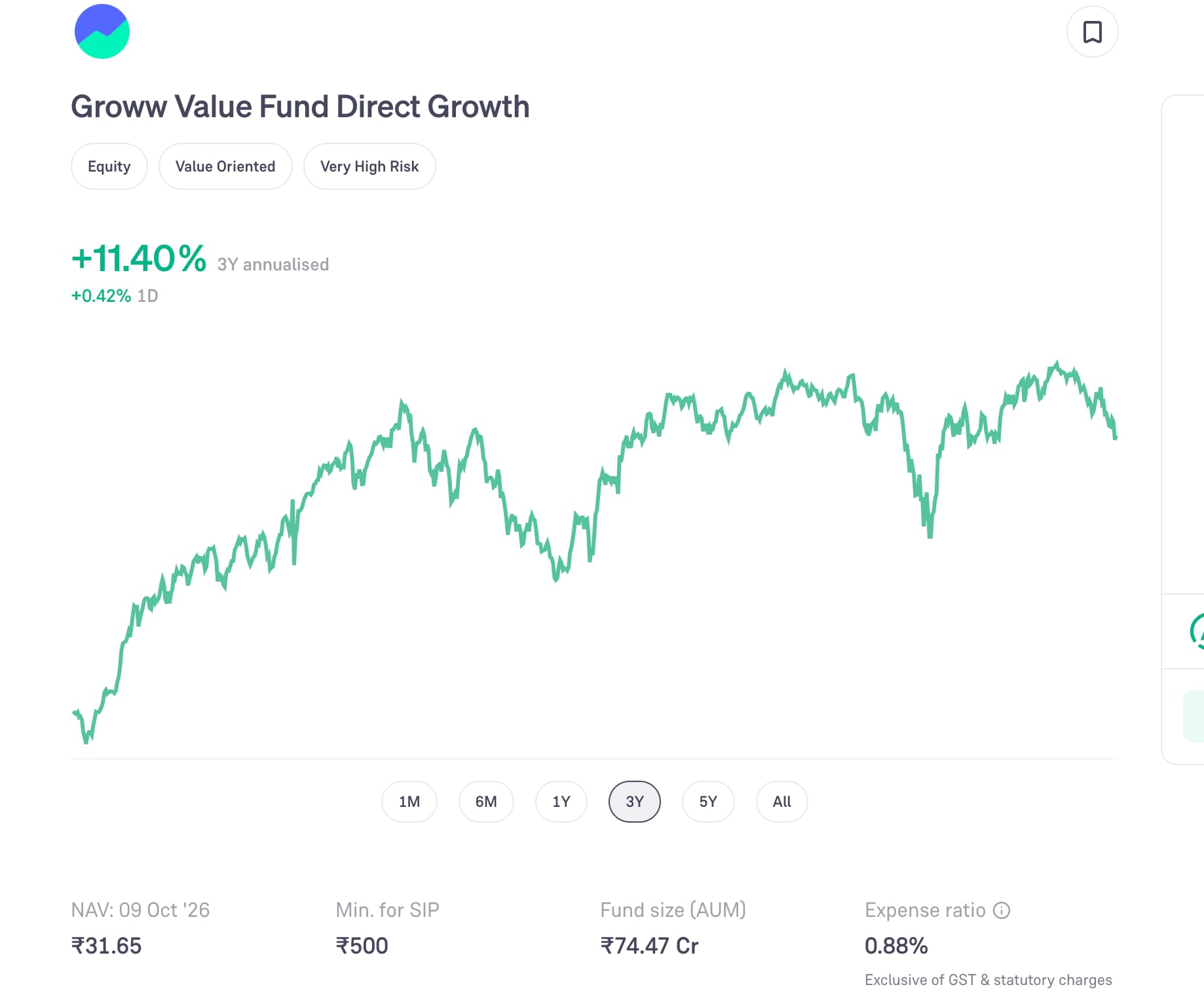
On the Groww website, the expense ratio appears at the top next to AUM. The number shown is the Base Expense Ratio (BER), not the Total Expense Ratio (TER). Click here to know what changed and why.
Conclusion
Total Expense Ratio (TER) is an important measure of the costs associated with investing in mutual funds. Since these expenses are reflected in the scheme's NAV, they directly influence the returns investors ultimately earn.
With SEBI's revised expense framework effective from April 2026, investors can distinguish between the base expense ratio and other permitted expenses that make up the overall TER.