Groww Now Shows Base Expense Ratio (BER) Instead of Total Expense Ratio (TER): Here's What Changed and Why
If you've checked a mutual fund's details page on Groww recently, you may have noticed a change: the expense ratio number shown up front is now the Base Expense Ratio (BER), not the Total Expense Ratio (TER) you may be used to seeing.
In this blog, we'll explain exactly what changed, why we made the switch, and why you may notice TER move around more than BER - using an example.
What Changed, and Why We Made the Switch?
An expense ratio is the cost a mutual fund scheme incurs to manage and operate the fund, shown as a percentage of its assets. It isn't deducted separately from your bank account - it's factored into the scheme's NAV, so the returns you see are already after accounting for it.
As per SEBI's framework, a scheme's Total Expense Ratio is made up of a few components:
TER = Base Expense Ratio (BER) + Brokerage cost + Transaction cost + Statutory levies (including GST)
This formula itself hasn't changed. What's changed is what Groww shows you as the primary number on a fund's details page: earlier, that number was TER. Now, it's BER. We made this switch because BER and TER behave very differently, even though neither's calculation has changed.
BER reflects the AMC's core management and operating cost, and is governed by SEBI's slab-based limits. It only moves when the AMC actually revises the scheme's cost structure, so it tends to stay stable for long stretches - making it a genuinely apples-to-apples number to compare across funds.
TER's other components - brokerage, transaction costs, and statutory levies - are based on actual trading activity and applicable rates in each reference period. That means TER can shift from one period to the next purely because a fund traded more or less, or because a levy like GST or STT changed - not because the fund got more or less expensive to manage. Two funds with an identical BER can show quite different TERs, simply because one trades more than the other.
This doesn't mean that your actual cost of investing in the fund has suddenly changed. Brokerage, transaction costs, and statutory levies were already being incurred and reflected in the fund's NAV.
The thing that has changed is the way the cost is presented: BER gives you a cleaner view of the fund's main management cost, while TER remains a broader measure that also includes trading-related and statutory costs that can vary from one period to another.
Before the new framework took effect on 1 April 2026, TER was generally a more stable number for a fund. Under the new framework, TER can move more noticeably from one period to another because it now separately reflects costs such as brokerage, transaction costs and statutory levies, which can vary based on actual trading activity and applicable rates.
This is why we now show BER as the primary expense ratio on Groww. BER focuses on the fund's core management and operating costs, while TER captures these costs along with trading-related and statutory costs that can vary from period to period.
Looking at both figures together can help in telling the difference between a real change in the cost of managing the fund and a temporary change in costs caused by trading activity or applicable levies.
BER vs TER: An Illustrative Example
Arbitrage funds work by constantly buying and selling to capture the price gap between the cash and futures markets. That means a lot of trading activity - and comparatively high brokerage, transaction costs, and statutory levies (like STT), relative to other fund categories.
Let us consider two arbitrage funds - Large Cap Fund X and Mid Cap Fund Y, with the total expense ratio (TER) and base expense ratio (BER) as follows -
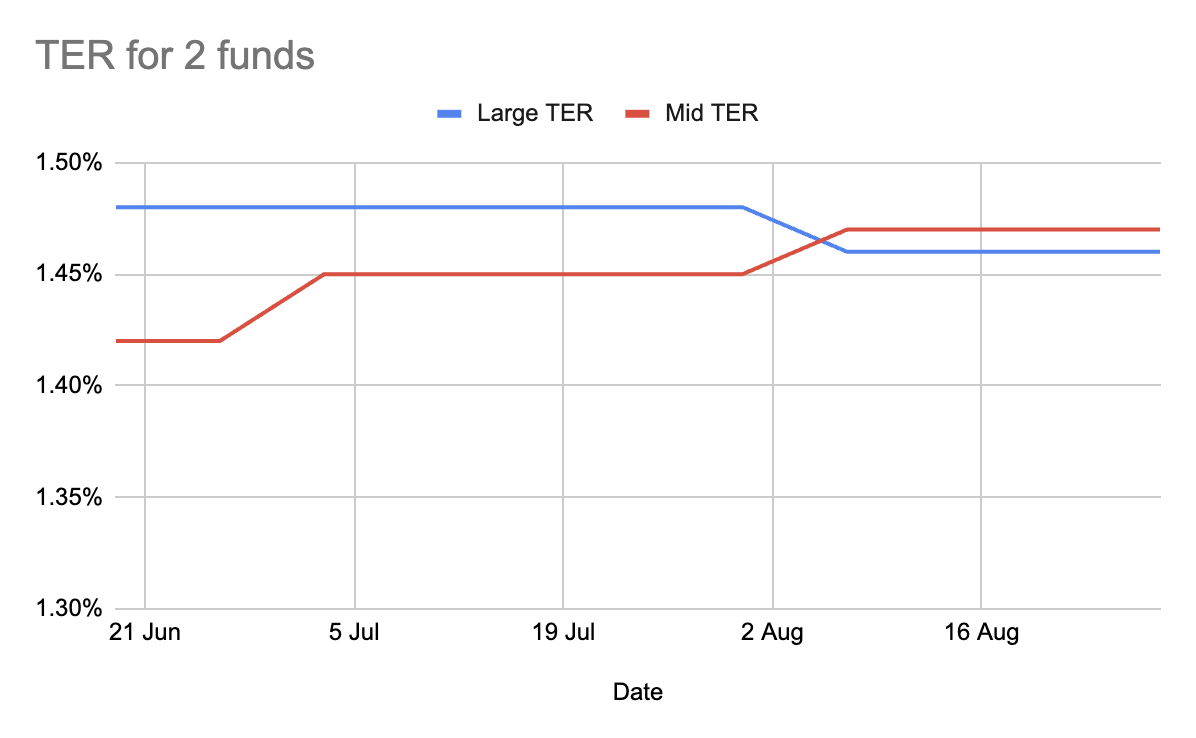
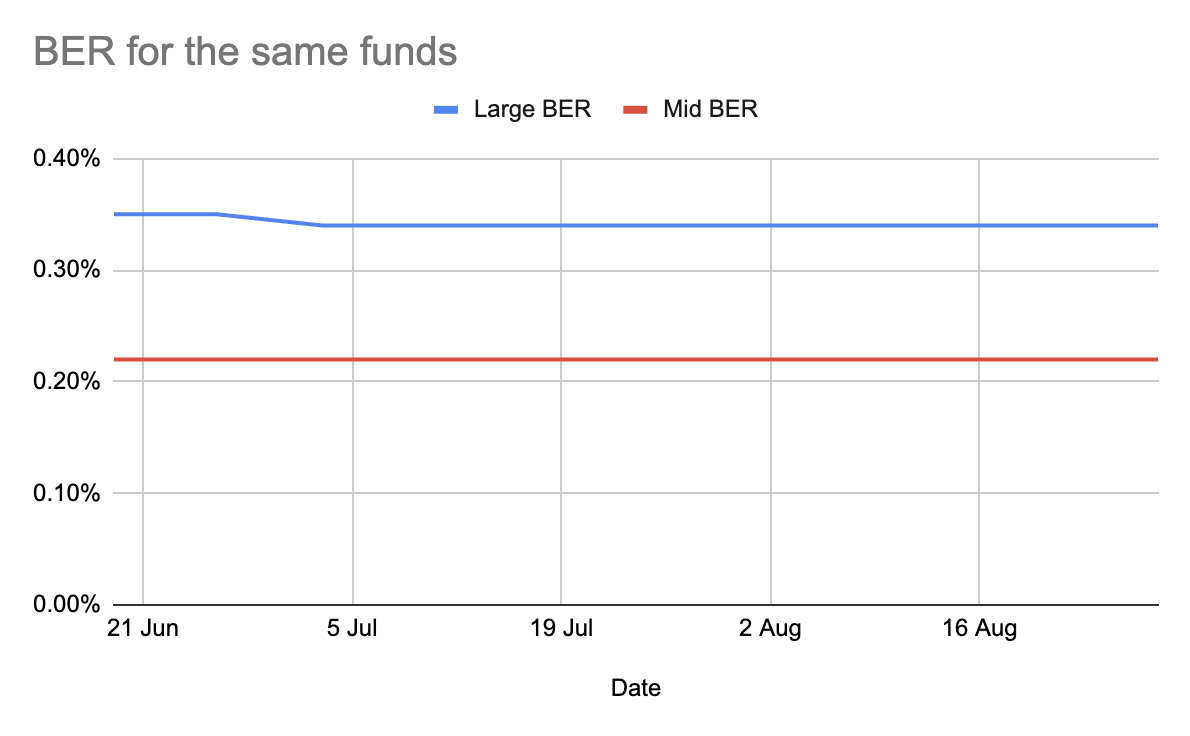
As you can see in the graph, the TERs for both funds, Fund X and Fund Y, are higher than their respective BERs due to trading-related and statutory costs.
If TER alone were shown as the headline number, one might assume the fund managers charge ~1.48% for Fund X and ~1.42% for Fund Y to run the scheme, when the core management cost (i.e., BER) is actually just ~0.35% and ~0.22%, respectively.
BER appears to remain unchanged when compared to its respective TER over a period, changing only when the AMC revises the scheme's cost structure. At times, it can remain unchanged even for months.
TER's brokerage and transaction-cost components, on the other hand, are based on actual trades from each reference period and reset accordingly, and its statutory levies move whenever applicable rates change - which is why TER is the more volatile of the two.
What You Pay, and How This Helps You?
You don't pay BER separately. As an investor, you bear the Total Expense Ratio (TER), which includes BER along with other applicable expenses, and this is already reflected in the mutual fund's NAV.
No separate deduction comes from your bank account; these expenses are accounted for when calculating the scheme's NAV. Broadly, a scheme's overall expense includes:
- Base Expense Ratio (BER) - core cost of managing and operating the scheme
- Brokerage - cost incurred for executing trades, subject to regulatory limits
- Transaction costs - costs associated with executing transactions
- Statutory and regulatory levies - charges such as GST, STT/CTT, stamp duty and other regulatory levies
Showing BER as the primary number gives you clearer visibility into a fund's core management cost - separate from trading costs and taxes that move with market activity.
And if a fund's BER does change, you can be confident its core cost structure has actually shifted, rather than reading too much into a TER movement that's really about trading behaviour.
|
Use case |
What to use |
Why |
|
Comparing management costs across funds |
BER |
BER shows what the AMC charges to manage and operate the scheme, without the effect of differences in trading activity. This makes it useful for comparing the core management cost of similar funds, such as two large-cap funds. |
|
Tracking whether a fund's management fee has changed |
BER |
A change in BER indicates that the scheme's underlying cost structure has changed. A change in TER alone may instead reflect variations in trading costs, transaction expenses or statutory levies. |
|
Understanding the fund's overall cost and return drag |
TER |
TER captures the broader costs borne by the scheme and reflected in its NAV. It is therefore the relevant measure when assessing the fund's overall cost to investors. |
|
Evaluating high-churn, arbitrage or F&O-oriented funds |
TER |
For strategies where trading activity is integral to the investment approach, trading and transaction costs are a genuine part of running the strategy. TER captures these costs, whereas BER alone would not. |
Looking at both BER and TER gives a more complete picture, since BER indicates the fund's core management costs, while TER shows the wider range of costs actually borne by the scheme. This distinction helps to explain whether a difference in costs is due to the AMC's fee structure or to factors such as trading activity and statutory charges.
Where You Can Find This on Groww?
Step 1
Search for the mutual fund you're interested in and open its fund details page.
Step 2
Go to “Expense ratio, exit load & tax.” Here, you'll see the applicable expense ratio information along with other costs such as exit load and tax. The expense ratio shown here is the Base Expense Ratio (BER).
Step 3
Tap on “Understand terms” to see an explanation of BER, TER and other related costs.
Frequently Asked Questions
Who decides or declares the expense ratio?
The Asset Management Company (AMC) determines and discloses the applicable expense ratio of its mutual fund schemes, subject to the limits and disclosure requirements prescribed by SEBI.
What charges are covered in TER?
TER represents the broader total expense of a mutual fund scheme: TER = BER + applicable brokerage + transaction charges + statutory levies (including GST).
Can the expense ratio on Groww change?
Yes. The applicable figures can change based on:
- Changes in the scheme's AUM
- Changes in the applicable BER slab
- Changes in the actual expenses incurred by the scheme
- Changes in brokerage or transaction costs
- Changes in applicable statutory levies
- Regulatory changes
How often does BER change, versus TER?
BER doesn't change at a fixed frequency - it moves only when the AMC revises the scheme's core expenses, so it can stay unchanged for months at a stretch. TER moves more often, because its brokerage and transaction-cost components are based on actual trading activity in each reference period, and its statutory levies can change with government rates. This is why BER, not TER, is the steadier number to use when comparing funds.
Other Updates