What Are State Development Loans (SDLs)? Features, Risks & How to Invest
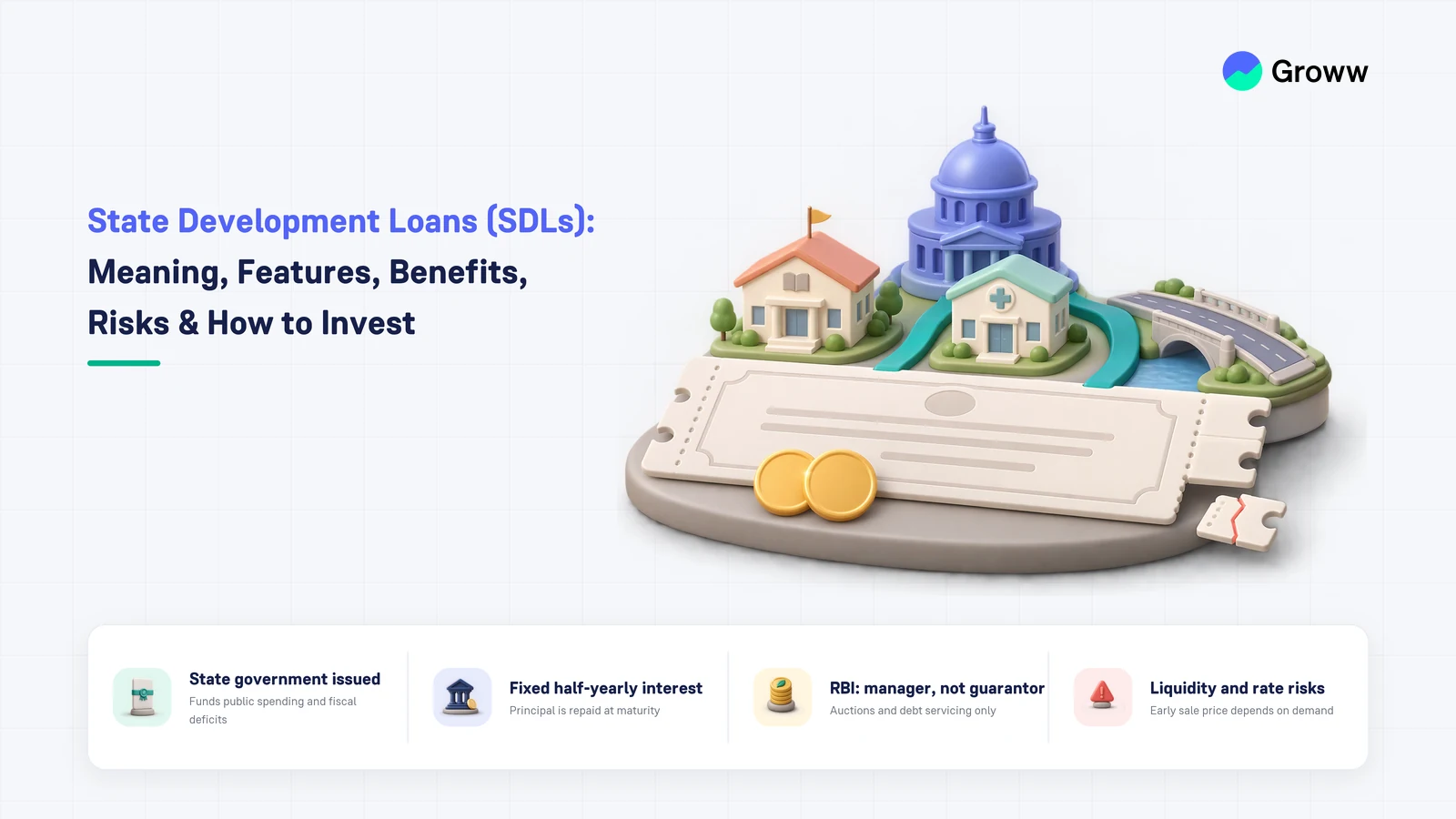


State Development Loans (SDLs) are debt securities issued by state governments in India to fund public spending and fiscal deficits. They offer fixed interest payments, generally every six months, with the principal repaid at maturity. Understanding their features, risks, taxation, and investment options can help investors compare SDLs with other government securities.
Key Takeaways
- State Development Loans (SDLs) are debt securities issued by state governments to fund public spending and fiscal deficits.
- The RBI manages SDL auctions and facilitates debt servicing, but it does not guarantee repayment.
- SDLs offer fixed interest payments, usually made every six months, with the principal repaid at maturity.
- SDLs typically have lower liquidity than Government Securities (G-Secs), which can make selling them before maturity more difficult.
- Although SDLs generally carry low credit risk, they are subject to interest rate, liquidity and state fiscal risks.
- Investors can access SDLs through RBI Retail Direct, eligible brokers or debt mutual funds.
- Interest income is generally taxed at the applicable income tax slab rate, while capital gains are taxed according to the holding period and applicable tax rules.
What Are State Development Loans (SDLs)?
State Development Loans (SDLs), also known as State Government Securities (SGSs), are dated debt securities issued by state governments to fund their fiscal deficit and public spending. Investors lend money to the state for a fixed tenure. In return, the state pays a fixed interest rate every six months and repays the principal on the maturity date.
The Reserve Bank of India (RBI) manages SDL auctions and facilitates interest payments and principal repayments on behalf of state governments. However, SDLs remain obligations of the respective state governments and are not guaranteed by the RBI.
Why Do State Governments Issue SDLs?
State governments issue State Development Loans (SDLs) to raise funds when revenue from taxes, grants, and other sources is insufficient to meet expenditure. These borrowings help finance infrastructure projects such as roads, irrigation, and power, as well as healthcare, education, and welfare schemes. SDLs also help states finance their fiscal deficits, which arise when total expenditure exceeds total receipts, excluding borrowings.
The Central Government raises funds through Treasury Bills and dated securities, while state governments primarily borrow through State Development Loans (SDLs).
Key Features of SDLs
-
Issuer and RBI’s Role: State governments issue SDLs to raise funds. The Reserve Bank of India (RBI) manages the auctions, debt servicing and related processes on their behalf. However, the RBI does not guarantee SDLs.
-
Coupon Rate and Interest Payment: SDLs carry a fixed coupon rate determined at the auction. Interest is generally paid every six months throughout the security’s tenure.
-
Maturity Period: SDLs are generally long-term securities, with 10-year maturities commonly issued. Other maturities are also available, allowing investors to choose securities based on their investment horizon.
-
Face Value and Minimum Investment: Each SDL unit has a face value of ₹100. The minimum investment may vary by purchase route and platform, so investors should check the applicable requirements before investing.
-
Listing and Demat Holding: SDLs are held in dematerialised form, are listed on NSE and BSE, and can be sold in the secondary market before maturity, though trading volumes are thinner than for G-Secs.
SDLs vs G-Secs vs T-Bills
State Development Loans (SDLs), dated Government Securities (G-Secs) and Treasury Bills (T-Bills) are government securities issued through RBI-managed auctions. They differ in issuer, maturity, interest payments and liquidity.
|
Parameter |
State Development Loans (SDLs) |
G-Sec (dated) |
T-Bill |
|
Issuer |
State Government |
Central Government of India |
Central Government of India |
|
Maturity |
Varies. 10-year maturities are common |
Varies by issue |
Less than 1 year. Typically 91, 182 or 364 days |
|
Interest |
Typically fixed coupon, half-yearly |
Fixed coupon, half-yearly |
No coupon. Issued at a discount and redeemed at face value |
|
Liquidity |
Generally lower than G-Secs |
Generally high |
Generally high |
In general, SDLs may offer higher yields than comparable G-Secs, but may have lower secondary-market liquidity. The actual yield difference varies with market conditions and the security's maturity.
SDLs vs state-guaranteed bond
State Development Loans (SDLs) are issued directly by state governments, whereas state-guaranteed bonds are issued by entities such as state-owned companies or development corporations, with repayment backed by a state government guarantee. In an SDL, the state government is the borrower. In a state-guaranteed bond, the entity borrows, and the state government provides a guarantee, subject to its terms.
How Are SDLs Issued?
State Development Loans (SDLs) are issued by state governments through auctions conducted by the Reserve Bank of India (RBI). The process involves announcing the borrowing plan, inviting bids and allotting securities to successful bidders.
-
Auction Calendar and Notification: The RBI publishes an indicative auction calendar in advance and notifies investors of upcoming SDL auctions, including the issuing states, borrowing amounts and maturities.
-
Bidding and Allotment: The RBI conducts SDL auctions electronically. Institutional investors can submit competitive bids by specifying the yield they require. Individual retail investors can participate through non-competitive bidding, typically via RBI Retail Direct. Allotment follows the applicable auction rules, and the yield is determined through the bidding process.
-
Settlement and Listing: After allotment, SDLs are credited to investors’ eligible securities accounts, and payment is settled through the prescribed process. SDLs can be traded in the secondary market through the RBI’s NDS-OM platform and, where available, on stock exchanges such as the NSE and BSE.
Benefits of Investing in SDLs
-
Low Credit Risk: SDLs are obligations of state governments and are generally considered to carry low credit risk. However, they do not have an RBI guarantee.
-
Potentially Higher Yields Than G-Secs: SDLs generally offer higher yields than Central Government Securities (G-Secs) of similar maturities, providing additional returns in exchange for differences in liquidity and risk.
-
Predictable Interest Income: SDLs typically pay interest at a fixed rate every six months, providing a regular income stream. The principal is repaid at maturity, subject to the terms of the security.
-
Portfolio Diversification: SDLs provide exposure to state government securities alongside other fixed-income investments, such as G-Secs, fixed deposits and debt funds.
-
Multiple Investment Routes: Retail investors can purchase SDLs through RBI Retail Direct or eligible secondary-market platforms. Debt mutual funds that invest in SDLs offer an alternative for those who prefer investing through funds.
Risks and Limitations of SDLs
SDLs are generally considered low-credit-risk investments, but they are not risk-free. Some of the risks to consider while investing in SDLs include:
- Interest Rate Risk: SDL prices can fall when market interest rates rise. Longer-maturity SDLs are generally more sensitive to these changes.
- Liquidity Risk: SDLs may be harder to sell quickly than G-Secs, and selling before maturity may result in a lower price.
- Reinvestment Risk: Interest payments may earn lower returns when reinvested if market rates fall.
- State Fiscal Risk: Changes in a state’s financial position can affect how the market values its SDLs and influence their yields.
How Are SDLs Taxed?
Interest earned on SDLs is taxed at your applicable income tax slab rate, while gains from selling them are taxed under the applicable capital gains rules.
|
Income Type |
Tax Treatment |
|
Interest Income |
Taxed at your applicable slab rate |
|
Short-term capital gains (held for 12 months or less) |
Taxed at your applicable slab rate |
|
Long-term capital gains (held for more than 12 months) |
Taxed at 12.5% without indexation, subject to applicable rules |
If you invest through a debt mutual fund instead, the fund's gains are taxed at your slab rate, so the tax result differs from holding SDLs directly.
How to Invest in SDLs?
Retail investors can invest in State Development Loans (SDLs) directly through RBI Retail Direct, buy them in the secondary market through eligible platforms, or gain exposure through debt mutual funds that hold SDLs. The suitable route depends on the investment amount and whether you prefer to hold SDLs directly or through a fund.
RBI Retail Direct
RBI Retail Direct allows individuals to invest in SDLs through primary auctions and access eligible securities in the secondary market.
- Register on the RBI Retail Direct portal using your details.
- Complete the required KYC formalities and link your bank account.
- Check the auction schedule and select the SDL you wish to bid for.
- Submit a non-competitive bid, subject to the applicable minimum investment and auction rules.
- If allotted, the SDL is credited to your account, and interest is paid according to its terms.
You can also buy or sell eligible SDLs in the secondary market through the portal, subject to availability and liquidity.
Stock Exchanges or Broker Platforms
Investors can purchase listed SDLs in the secondary market through eligible brokers or platforms that offer these securities. Open a demat account, search for available SDLs, compare their yields and maturity dates, and place an order. Availability depends on market demand and trading activity.
Debt Mutual Funds
Investors can gain indirect exposure to SDLs through debt mutual funds that invest in state government securities. You can invest through a mutual fund platform without bidding in SDL auctions or selecting individual securities. However, returns depend on the fund’s portfolio and market conditions, and they are not guaranteed.
Who Can Consider Investing in SDLs?
State Development Loans may suit investors seeking relatively low credit risk and predictable interest income, particularly those with a longer investment horizon who can hold the securities until maturity. They may also appeal to investors looking for potentially higher yields than G-Secs.
Investors with smaller amounts to invest can consider debt mutual funds that hold SDLs. However, SDLs may be less suitable for those who need quick access to their money, as selling before maturity depends on market demand and liquidity.
Things to Check Before Investing in SDLs
- Financial Position of the Issuing State: Review the state’s debt levels, fiscal deficit and overall financial position to understand its fiscal health and borrowing patterns.
- Yield Spread over G-Secs: Compare the SDL’s yield with that of a Central Government Security (G-Sec) of similar maturity. This helps you assess whether the additional yield compensates for differences in liquidity and risk.
- Maturity Period: Check the SDL’s maturity date and ensure it aligns with your investment horizon and when you expect to need the funds.
- Liquidity Requirements: SDLs can be sold before maturity, but finding a buyer at a favourable price may be difficult. Consider your need for readily accessible funds before investing.
- Tax Implications: Interest income is generally taxed at your applicable income tax slab rate, while gains from selling SDLs are subject to capital gains tax rules. Consider the tax impact when comparing returns with other fixed-income investments.
Conclusion
State Development Loans (SDLs) offer periodic interest income and a defined maturity period. Before investing, consider their yields, maturity, liquidity and tax implications to determine whether they suit your financial goals and investment horizon.