How to Add More Margin to an MTF Position?



When you take a Margin Trading Facility (MTF) position, it allows you to buy stocks by paying only a fraction of the total amount upfront. The remaining amount is funded by your broker and you pay a daily interest rate on the borrowed amount.
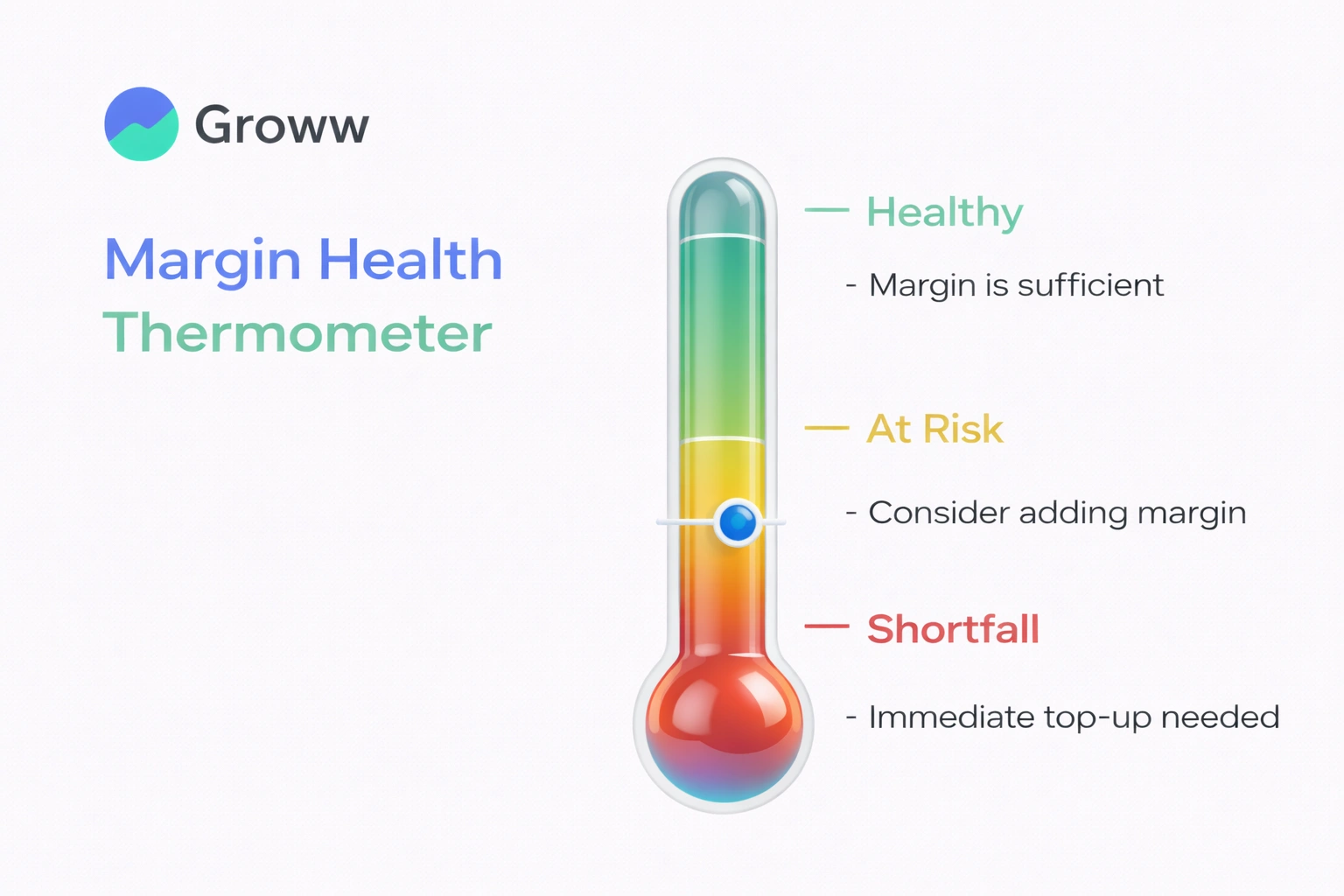
But once your MTF position is active, market movement, haircuts, and regulatory requirements can change your margin needs. This is when you may have to add more margin to maintain your position and avoid a margin call.
Why You Might Need to Add Margin?
If the Stock Price Falls
A fall in the stock price directly affects the value of your MTF position. As the stock loses value, your margin requirement increases to ensure the position remains funded.
For Example,
If your MTF exposure is ₹1,00,000 and you initially contributed ₹25,000 as margin, even a moderate price drop can raise the required margin. To maintain the position, you must contribute the shortfall promptly.
If there is a change in Haircut Percentage
Brokers apply a haircut on pledged shares to account for price volatility. If the haircut increases (due to volatility or regulatory updates), the usable collateral also reduces. Hence, you need to add more margin for the shortfall.
For Example:
You have pledged shares worth ₹1,00,000. Now, if the haircut increases from 20% to 30%, the usable margin will reduce to ₹70,000 (earlier margin was ₹80,000). Hence, you must add ₹10,000 to make up for the shortfall.
Due to Exchange or Regulatory Updates
SEBI and stock exchanges regularly update their margin rules to manage market risk. Brokers may also revise their requirements based on changing conditions. When these rules change, the margin needed for your MTF position can increase even if the stock price is stable.
If You Increase Your MTF Exposure
Adding more quantity to an existing MTF position automatically raises the total exposure.
If your current margin is fully utilized, the system will prompt you to add additional margin to support the increased position size.
Due to Interest Charges or Outstanding Debit Balances
MTF positions carry daily interest on the amount financed by the broker. Over time, this interest can add up and create a debit balance in your account. When that happens, you may need to add cash margin to keep your position compliant. This situation is more common for traders who hold MTF positions for longer periods.

During High Market Volatility
Even if your specific stock remains steady, broader market volatility triggered by events such as economic announcements, global news, or sector-wide movements can prompt brokers to tighten margin requirements. This is done to ensure sufficient risk coverage, which may result in a request for additional margin.
Collateral vs Cash Margin - How are they Different?
When you want to add margin to an MTF position, you can do it in two ways, i..e, either through Cash Margin or by Collateral Margin. Both serve the same purpose by adding additional margin to your MTF position, but they work very differently.
Let’s break it down in a simple way.
What is Cash Margin?
Cash margin is a process where you can simply add money from your bank account into your trading account to support your MTF position.
For example,
Imagine your MTF position needs ₹5,000 more margin because of decline in the stock price.
In this case, you open Groww → click Add Margin → pay ₹5,000 via UPI → your margin shortfall is immediately fixed.
No waiting. No approval steps. No haircut.
This makes cash margin ideal for urgent situations.
What is Collateral Margin?
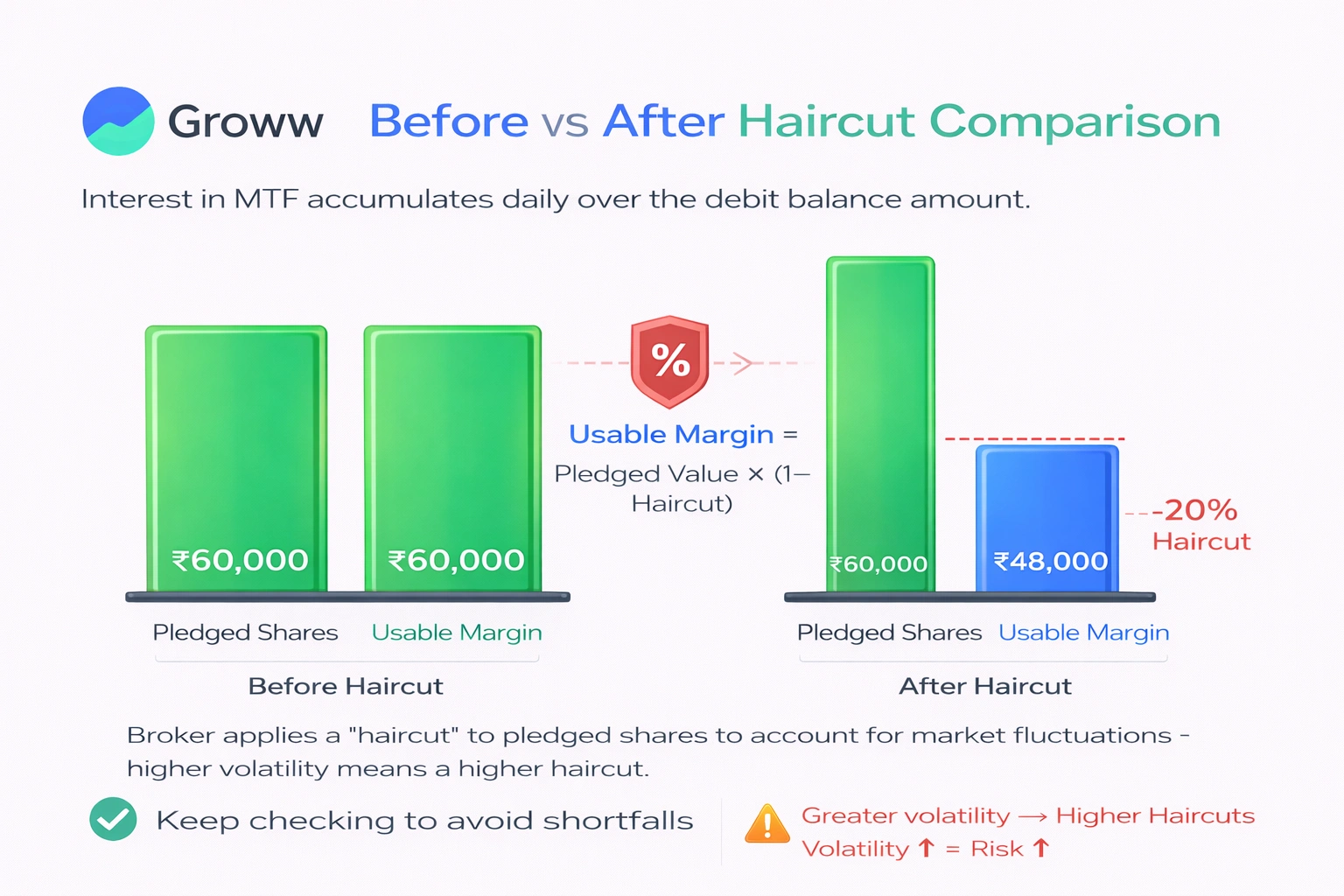
Collateral margin is margin you receive by pledging the shares or ETFs you already hold. You choose any approved shares or ETFs from your holdings, pledge them and the broker gives you margin after applying a haircut.
For example, suppose you pledge shares worth ₹60,000 and a haircut of 20% is applied by the broker.
Then, usable margin = ₹60,000 - 20% of ₹60,000
= ₹48,000
Hence, this ₹48,000 can be used as margin for your MTF positions.
How to Add Margin via Groww?
Groww allows you to add margin in two ways — by adding cash or by pledging shares/ETFs as collateral.
Given below is the step-by-step process to add more margin to your MTF position on Groww by cash margin and pledging.
Steps to Add Cash Margin on Groww
- Open the Groww app or website. Log in using your credentials and navigate to the Stocks section.
- Go to ‘Positions’ tab. Here, you will see all your active trades, including MTF positions.
- Select the MTF position where margin is required.
- Tap on ‘Add Margin’. This option appears only for positions that are eligible for margin top-up.
- Enter the amount you want to add.
- Choose your payment method.
- Confirm the payment. Once the payment is completed, the margin usually reflects instantly.
Steps to Add Collateral Margin/Pledge Margin on Groww
- Go to the ‘Holdings’ tab on the Groww app/website. This displays all your stocks and ETFs.
- Select the shares you want to pledge. Only approved stocks and ETFs can be pledged.
- Tap ‘Pledge for Margin’. You will see the haircut and estimated margin before confirming.
- Confirm the pledge request.
- Approve the pledge through CDSL TPIN/OTP.
- CDSL sends a link or notification where you must verify the pledge using TPIN or OTP sent to your registered mobile/email. This step ensures secure pledging.
- Wait for margin to reflect. Once the pledge is approved, your margin updates automatically. This may take a few hours but is usually completed the same day.
Timeline for Margin Updates
There are several operational timelines that are applicable for individual traders using MTF:
- Pledge Creation: Shares purchased under MTF must be pledged on the same day of purchase (T-day), specially before a specific cut-off time (e.g., 8:00 PM or 9:00 PM, depending on the broker). Failure to do so requires the client to pay the full amount or face potential square-off.
- Margin Calls (Shortfall): If the stock value drops and a margin shortfall occurs, brokers will issue a margin call. Clients are generally given a grace period to add funds:
- The margin needs to be added within a maximum of 5 working (trading) days from the day the margin call is made, as per broker policy.
- Brokers may have stricter internal policies; for example, some might require funds to be added before 8:45 AM on T+1 day to avoid liquidation.
- MTM (Mark-to-Market) Adjustments: MTM losses on open MTF positions are collected daily and reset each day.
- Fund/Profit Availability: Profits from MTF trades become available for use on the next trading day (T+1 day) after market hours.
- Position Expiry: MTF positions can be held for a maximum of 360 days. If held beyond this, the position may be automatically squared off or converted to delivery if fully paid for.
Margin Call Scenarios
A margin call or shortfall can occur when the available margin for your MTF position falls below the required margin level. This situation can occur due to changes in price, volatility, or collateral value.
Here are some common margin call scenarios that traders must be aware of:
Fall in Stock Price
If the stock price for your MTF position falls significantly below, the margin requirement for that particular position increases leading to a margin shortfall.
Drop in Collateral Value
In case of pledged shares, if the collateral value of the shares decreases, it leads to an increase in MTF haircut. This means the risk percentage assigned to the stock has risen, reducing the collateral value of your holdings. In such scenario, you need to add more cash or securities to avoid a margin shortfall.
Increasing the MTF Quantity
Adding more quantity to your MTF position without increasing margin can result in a shortfall.
Accumuated Debit Balance
MTF positions carry a daily interest on the amount funded by the broker. Over time, this interest adds up and increases your outstanding balance.
If the accumulated interest creates a debit balance in your account, you may need to add cash margin to regularize it and continue holding the position.
Regulatory Changes
Stock exchanges and brokers periodically revise margin requirements based on market risk conditions.
If these requirements increase, the required margin for your MTF position will also increase even if the stock price remains same. This can lead to a margin call situation.
Best Practices for Margin Management
Monitor Your MTF Positions Regularly
MTF positions are sensitive to price movements, haircut changes, and daily MTM adjustments. Make it a habit to track:
- Margin utilization
- Collateral value
- Daily MTM impact
- Accumulated interest
Always Maintain a Margin Buffer
Avoid using your entire available margin. Keeping a buffer (for example, 10–20% above the minimum margin requirement) helps during short-term volatility and reduces the risk of frequent margin calls.
Diversify Your Pledged Collateral
If you use pledged shares for margin, avoid concentrating collateral in a single volatile stock. A diversified set of stable securities reduces the risk of sudden haircut revisions impacting your margin availability.
Avoid Over Leverage
While MTF increases buying power, excessive leverage magnifies losses just as quickly as gains. Align leverage with:
- Risk appetite
- Market conditions
- Portfolio size
Respond to Margin Calls Immediately
Margin calls should never be ignored or delayed. Even small shortfalls can trigger automated square-offs depending on broker policy.
Managing margin is an important part of trading through MTF. Since leverage increases both potential returns and risk, changes in price, collateral value, or regulations can require you to add more margin. By understanding when margin shortfalls can happen and responding quickly you can keep your MTF positions active and avoid unnecessary square-offs.