Closing Auction Session (CAS): Meaning, Timings, Process


The closing price of a stock is one of the most important reference points in the securities market. It is used to calculate benchmark indices such as the Nifty 50 and Sensex, determine the Net Asset Value (NAV) of mutual funds and exchange-traded funds (ETFs), settle Futures and Options (F&O) contracts, and value investment portfolios.
Recognising the importance of an accurate closing price, the Securities and Exchange Board of India (SEBI) has introduced the Closing Auction Session (CAS) for eligible securities in the equity cash segment.
Effective 3 August 2026, the Closing Auction Session (CAS) will be introduced for eligible stocks in the Futures & Options (F&O) segment, replacing the existing closing price discovery methodology for those stocks.
Key Takeaways
- Closing Auction Session (CAS) is a dedicated 15-minute auction session conducted from 3:15 P.M. to 3:30 P.M., where the closing price is finalised anytime between 3:30 and 3:35, on all trading days to determine the official closing price of F&O-enabled stocks.
- SEBI has introduced CAS with effect from 3 August 2026, initially for stocks on which F&O contracts are available.
- During CAS, buy and sell orders are collected first and then matched together at a single equilibrium price, instead of being executed immediately.
- The equilibrium price is the price at which the maximum number of shares can be traded, and it becomes the stock's official closing price.
- CAS aims to improve price discovery, transparency, and the efficiency of executing large orders, while helping the closing price better reflect overall market demand and supply.
- Securities not covered under CAS will continue to follow the existing VWAP-based closing price methodology until notified otherwise.
Impact on Market Timings
Stocks
|
F&O-enabled stocks |
Non F&O-enabled stocks |
|||
|
Current |
New |
|||
|
Stocks, MTF |
9:15 A.M. - 3:30 P.M. |
9:15 A.M. - 3:15 P.M. |
No change (9:15 A.M. - 3:30 P.M.) |
|
|
No change (9:15 A.M. - 3:20 P.M.) |
||||
|
Intraday |
9:15 A.M. - 3:20 P.M. |
9:15 A.M. - 3:05 P.M. |
||
|
Intraday auto square-off timings: F&O-enabled stocks - 3:05 P.M. Non-F&O-enabled stocks - 3:20 P.M. |
||||
Derivatives
|
Futures & Options (Index & Stocks) |
|
|
Current |
New |
|
9:15 A.M. - 3:30 P.M. |
9:15 A.M. - 3:40 P.M. |
What is the Closing Auction Session (CAS)?
The Closing Auction Session (CAS) is an auction-based trading session introduced by the Securities and Exchange Board of India (SEBI) to determine the official closing price of stocks on which F&O contracts are enabled. The session is conducted from 3:15 P.M. to 3:30 P.M. on trading days.
Unlike the Continuous Trading Session (CTS), where buy and sell orders are matched and executed as soon as prices match, the Closing Auction Session first collects all eligible buy and sell orders during the auction window.
After the order entry period ends, the exchange determines a single auction price at which the maximum number of shares can be matched. All eligible trades are then executed at this price, which becomes the stock's official closing price for the day.
This auction-based approach helps ensure that the closing price reflects the overall buying and selling interest in a stock, rather than being influenced by a few trades executed just before the market closes.
Let us consider the following buy and sell orders during the Closing Auction Session:
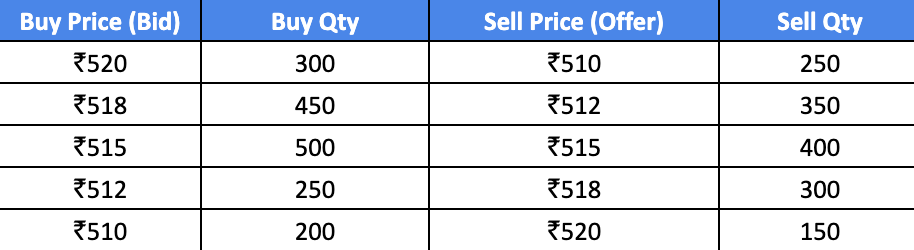
Here's what these orders mean:
- A buyer willing to pay ₹520 will also buy at ₹518, ₹515, ₹512 or ₹510 because these prices are lower than their limit.
- A seller willing to sell at ₹510 will also sell at ₹512, ₹515, ₹518 or ₹520 because these prices are higher than their asking price.
The exchange now checks each possible price one by one to see how many shares can actually be matched.
Market orders do not specify a price, so they are treated as willing to trade at any auction price.
As a result, all market buy orders are added to the cumulative buy quantity at every price level, and all market sell orders are added to the cumulative sell quantity at every price level.
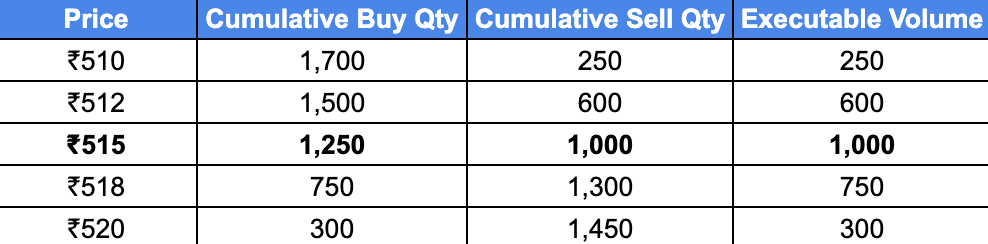
Since ₹515 has the highest executable quantity (1,000 shares), it is selected as the equilibrium price. All eligible trades are executed at ₹515, and this becomes the stock's official closing price.
Closing Auction Session (CAS) Timings
The Closing Auction Session (CAS) is conducted every trading day from 3:15 P.M. to 3:35 P.M. for stocks which have F&O contracts available. The session is divided into four stages, each serving a specific purpose in determining the official closing price.
|
Session |
Activity |
Start Time |
Duration |
|
1 |
Reference Price Calculation and Transition from the Continuous Trading Session (CTS) |
3:15 P.M. |
5 minutes |
|
2 |
Order Entry Period I (Market and Limit Orders) |
3:20 P.M. |
5 minutes |
|
3 |
Order Entry Period II (Only Limit Orders) No modification/cancellation for market orders, Random Close in the last 2 minutes* |
3:25 P.M. |
5 minutes |
|
4 |
Order Matching and Trade Confirmation |
3:30 P.M |
5 minutes |
*The order entry window closes at a randomly selected time between 3:28 P.M. and 3:30 P.M. This random closure helps discourage last-second order placement and supports a fairer price discovery process.
Note: Reference Price: The reference price for CAS is the Volume Weighted Average Price (VWAP) of trades executed during the last 30 minutes of the Continuous Trading Session (CTS). It serves as the starting reference for the auction and is different from the final closing price discovered through CAS.
Trading Timings for Other Market Segments
While stocks on which F&O contracts are available will follow the Closing Auction Session (CAS), other market segments will continue to operate as follows:
- For securities not covered under CAS, continuous trading will continue until 3:30 P.M., and the closing price will continue to be determined using the existing VWAP-based methodology.
- For the equity derivatives segment, trading will continue until 3:40 P.M. on all trading days.
- Additionally, a post close session in the cash segment will be held from 3:50 P.M. to 4:00 P.M., during which all trades will be executed at the closing price of the stocks.
Why Has SEBI Introduced the Closing Auction Session?
The closing price is one of the most important reference prices in the stock market. It is used for benchmark index calculation, mutual fund and ETF Net Asset Value (NAV) computation, derivatives settlement, portfolio valuation, and several other market activities.
Since these calculations rely on the closing price, it should accurately reflect the market's demand and supply at the end of the trading day.
SEBI introduced the Closing Auction Session (CAS) to improve the process of determining the closing price. The key objectives are:
- Better price discovery: By pooling all eligible buy and sell orders into a single auction, CAS helps determine a closing price that better reflects overall market demand and supply.
- Fair and transparent pricing: All participants place orders during the same auction window, enabling the closing price to be discovered through a uniform and transparent process.
- Improved execution of large orders: The common pool of liquidity increases the likelihood of matching large buy and sell orders, reducing their impact on market prices.
- Lower tracking error for passive funds: A more representative closing price helps index funds and ETFs track their benchmark indices more accurately.
- Alignment with global practices: Many leading stock exchanges across the world, including the NYSE and LSE, use closing auctions to determine official closing prices.
By introducing CAS, SEBI aims to strengthen the price discovery process and ensure that the official closing price more reliably reflects market consensus at the end of the trading day.
How Was the Closing Price Determined Earlier?
Before the introduction of the Closing Auction Session (CAS), the closing price of a stock was generally determined using the Volume Weighted Average Price (VWAP) of trades executed during the last 30 minutes of the Continuous Trading Session (CTS).
Unlike a simple average, VWAP gives greater weight to trades with higher volumes, making it a more representative measure of the prices at which a stock traded during that period.
VWAP = Sum (Price × Volume of each trade) ÷ Total Volume
Suppose the following trades take place during the last 30 minutes of trading:
|
Trade |
Volume |
Price (₹) |
Trade Value (₹) |
|
1 |
400 |
₹1,245 |
₹4,98,000 |
|
2 |
350 |
₹1,248 |
₹4,36,800 |
|
3 |
250 |
₹1,252 |
₹3,13,000 |
|
Total |
1,000 |
- |
₹12,47,800 |
VWAP = ₹12,47,800 ÷ 1,000 = ₹1,247.80
Therefore, ₹1,247.80 becomes the stock's official closing price under the earlier methodology.
Although this method considered both price and trading volume, it was still based only on trades executed during the final 30 minutes of the trading session. As a result, the closing price might not always reflect the overall buying and selling interest in the stock, particularly during periods of low liquidity or high market volatility.
Continuous Trading Session (CTS) vs Closing Auction Session (CAS)
|
Feature |
Continuous Trading Session (CTS) |
Closing Auction Session (CAS) |
|
Order Execution |
Orders are executed immediately when matching buy and sell orders are available. |
Orders are collected first and executed together after the auction concludes. |
|
Price Discovery |
Prices are discovered continuously throughout the trading session. |
A single equilibrium price is discovered through an auction. |
|
Closing Price Methodology |
Under the earlier methodology, the closing price was based on the VWAP of trades executed during the last 30 minutes of trading. |
The closing price is the equilibrium price at which the maximum number of shares can be matched. |
|
Timings |
Regular trading: 9:15 A.M. to 3:30 P.M. Volume-Weighted Average Price (VWAP) for closing price calculation: 3:00 to 3:30 P.M |
Regular trading: 9:15 A.M to 3:15 P.M Transition from CTS to CAS: 3:15 P.M. to 3:20 P.M. Order Entry Session I: 3:20 P.M. to 3:25 P.M. Order Entry Session II: 3:25 P.M. TO 3:30 P.M. Order Matching: 3:30 P.M. to 3:35 P.M. (for stocks on which F&O contracts are available). |
|
Primary Objective |
Facilitate continuous buying and selling of securities. |
Determine a fair and transparent official closing price. |
|
Order Matching |
Continuous matching throughout the session. |
Auction-based matching after the order collection period. |
Conclusion
The Closing Auction Session (CAS) marks an important step toward greater efficiency, transparency, and reliability in India's equity markets. By replacing the previous method with an auction-based mechanism, SEBI ensures that the official closing price more accurately reflects the market demand and supply, strengthening both price discovery and execution quality in the process. Since the closing price underpins everything from index calculations to fund valuations and derivatives settlement, this shift has implications that extend well beyond a single daily figure.
As the framework rolls out in phases, investors should familiarise themselves with the revised trading process and exchange notifications on which securities are covered, ensuring a smooth transition as the new system takes effect.