Best Intraday Trading Tips for Beginners & Pros
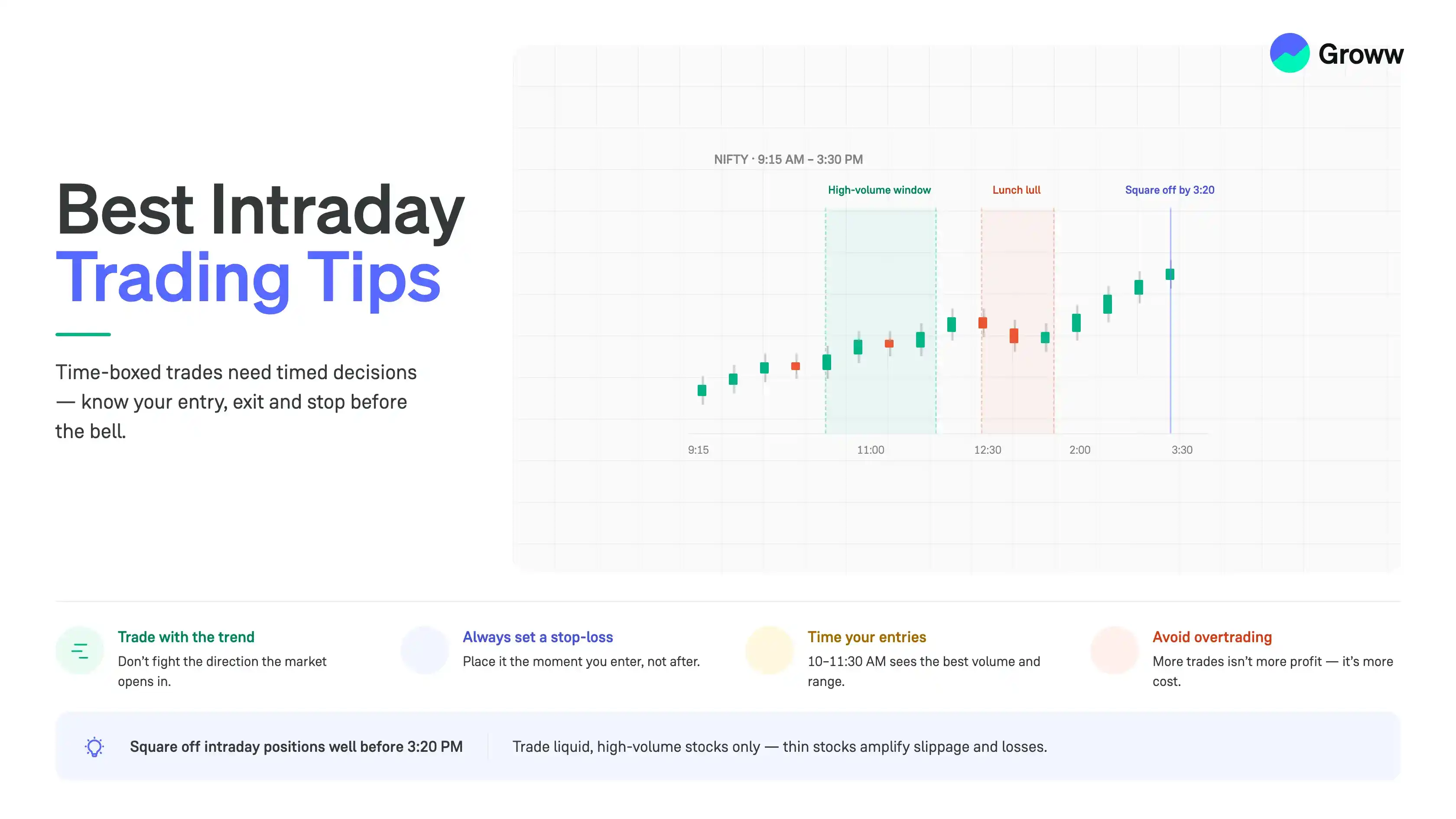


Intraday trading is a trading strategy in which investors invest their money in shares as soon as the share market opens or at any given time in the day and sell the same investment by the end of the trading session, which is by 3:30 pm.
There is either a profit or a loss by the end of the day, and this excites the investor to trade more intraday as, if there is a profit, the investor has earned that much in a day.
Intraday Trading Tips in India
To avoid incurring a loss in intraday trading, we have curated a list of some of the most useful intraday trading strategies. Here are some tips which may help investors to invest with precaution:
- Understand the terms of the intraday market such as long position, short position, stop loss, IOC, support level, and resistance level where:
-
- Long Position: It is buying on the belief that the share price will increase by the end of the trading session.
- Short Position: It is buying on the belief that the share price will decrease by the end of the trading session.
- IOC (Immediate or Cancel): It is an order that must be executed immediately in the market, as any unexecuted order will get cancelled.
- Support Level: It is the base price below which the share price of the company does not fluctuate.
- Resistance Level: It is the opposite of the support level, which is the highest price of the share that is taken into consideration.
- Stop Loss: It is the range an investor sets. If the share goes below this value, the brokerage will automatically share the same at a price set on the stop loss.
- Your intraday portfolio should always have two or three liquid shares, which are generally large-cap company shares recommended for squaring off the open positions.
- Research the shares that are in the news and invest in them, as the increase in demand will increase the volatility of the share and may give good profits in the intraday trading session.
For example, Pharma companies’ shares were perfect for intraday trading when the government was approving vaccines for corona.
- Another one of the significant intraday trading tips India is that Investors should always have a calm, clear mind while determining the stop loss limit in share trading. Sometimes after a dip, the share price again rises to a high.
But this is not conclusive, so keeping a stop loss value will automatically sell your share before going into a dip and prevent the investor from incurring a loss. - Vice versa, the investor should not be greedy when the share hits an all-time high in the day trading session with the mindset that it may increase some more because the chances are high that it may go south. Hence, an investor should book profit at a good profit level and exit the share with the target achieved.
- The stock market is never predictable. Some investors do fundamental analysis while some may use technical analysis, but still, both suffer losses as these analyses are not concrete and are merely indicative.
Thus, if an investor feels that there may be a rise in the stock price based on his analysis, but in reality, there is a steady decline, an investor should not wait and must sell off the share before facing a huge loss.
- One of the most interesting intraday tips is that investors in intraday should trade safely with their finances as, in the hopes of larger profits, an investor may pitch in large sums of money and end up losing the same. This has happened in the past as the stock market is said to be unpredictable.
Hence, investors should only invest the money which is in surplus or would not impact their livelihood in any drastic manner.
- A very important thing an investor must consider is to determine Entry and Target Prices before he/she places the buy order. An investor’s mind usually dwells from time to time while purchasing shares. He may end up selling even if the price tends to observe a nominal increase.
Because of this, you may happen to lose the opportunity to gain higher gains due to an increase in price.
You may also want to read Intraday Trading Guide for Beginners in India
Key Factors to Consider When Choosing Intraday Stocks
Choosing intraday stocks requires following a process with key points in mind. These include:
- Volume and liquidity: Look for stocks with high daily trading volume, e.g., 1 million shares.
- Volatility: Consider choosing stocks that witness considerable price movements throughout the day (about 2-3%). However, do so cautiously and avoid stocks with sudden, sporadic, or unexplained surges.
- Top gainers/losers: Keep monitoring the top losers or gainers of the day for momentum trading. This is because they usually continue the trend in question.
- Sectoral trends: Look for stocks that move with the overall market (Nifty). Alternatively, focus on stocks that are leading a specific sector, such as banking, IT, and so on.
- News-driven stocks: You can follow companies that have any upcoming earnings reports, major announcements, corporate actions, or updates.
- Technical evaluation: Focus on stocks that are breaking out of their earlier day’s low or high. You can also look for stocks trading below or above the Volume Weighted Average Price (VWAP).
- Filter your watchlist: Maintain a limited list of 8-10 familiar stocks, rather than searching the entire market, to save time.
- Confirming trends: Make sure you check the technical chart patterns, e.g., trendline breakouts or bull flags, before you take any position.
Using Liquidity and Volatility Filters for Stock Selection
There are several key liquidity and volatility filters to keep in mind. Liquidity Filters (liquidity ensures that you can easily exit or enter positions instantly without considerably shifting the stock prices):
- High trade volume: Stocks with high daily trading volume to ensure adequate liquidity.
- Low bid-ask spread: Stocks where there is a minimal difference between the bid (buy) and ask (sell) price.
- Top 100/Nifty 50 stocks: In most cases, large-cap stocks in the country, such as State Bank of India, Tata Motors, and Reliance Industries, tend to have the highest liquidity levels.
- Bypass illiquid small-cap stocks: Bypass stocks that usually witness sporadic trading activities, since you may be unable to sell them otherwise.
Minimum Liquidity Filters:
- Minimum volume: An ADV (average daily volume) exceeding 10 lakh (1 million) shares ensures convenient entries and exits.
- Liquidity ratio: Average Daily Volume by Market Capitalisation, with a minimum target being 10%.
- Price and spread: Focus on stocks priced above ₹100 with a narrow bid-ask spread.
- Futures and options (F&O) segment preference: Focus on futures and options (F&O) stocks which are most liquid. They are tougher to manipulate, thereby ensuring improved stability.
- Impact cost: Stocks with low impact costs, ideally less than 0.1%, ensure higher liquidity and narrower price gaps for bigger orders.
- Volatility: Use of ATR (average true range) to estimate whether the stock has ample daily movements to ensure profit potential.
- Market timing: Try trading in the first hour (9.15-10.15 AM) and after 1.30 PM for higher volumes and price movements.
Volatility Filters:
- Moderate volatility: Consider bypassing highly volatile stocks (>3-4% daily movements), as they may trigger stop-losses prematurely. Find stocks that move but not in a sporadic manner.
- Average True Range (ATR): Make use of the ATR indicator to track the volatility of a stock and filter stocks that sync with your risk tolerance levels.
- 52-week high/low evaluation: Analyse the proximity of a stock to its 52-week high or low to estimate potential movements.
- Dynamic stop-loss formulation: Rather than a fixed amount, work out stops with the ATR to adapt to the noise in the market.
- Volatility filter for breakouts: Consider entering breakout trades when the current ATR is rising.
- Filtering out initial noise: Ignoring price movements smaller than a specified percentage of the daily ATR to avoid false signals. This holds true, especially for highly volatile stocks like the NSE Nifty Index and Tata Motors.
- Combined indicators (RSI + ATR): You can use the ATR for confirming the strength of the volatility that is behind an RSI overbought, i.e. >70, or oversold, i.e. <30 signal. This helps filter out any weaker reversals.
- Session-anchored VWAP: When used with the ATR, it serves as a reference value, ensuring trades align with the day's volume-weighted average price. It also helps you filter against any false trends.
Risk Management and Position Sizing
Here are some risk management rules you can follow for intraday trading in India -
- The 1% thumb rule: You should not risk any more than 1-2% of your overall trading capital on just one trade. So, if you have ₹50,000, for example, do not end up risking more than ₹500-1,000 per trade.
- Compulsory stop-loss: Always use a stop-loss to exit your losing positions automatically at technical levels, such as VWAP and support/resistance, rather than arbitrary percentages.
- Risk-reward ratio: Target a 1:2 or 1:3 ratio in this case. So, you can risk ₹2 to earn ₹4 or ₹6. This approach ensures higher chances of profitability even when 50% of your trades fail.
- Controlling overtrading: Avoid more than 3-5 trades per day for managing transaction costs.
- Daily loss limit: Set your maximum loss limit for the trading day, i.e. 5-10% of your capital. If this is reached, stop trading immediately.
Position Sizing:
Position sizing helps determine how many shares to purchase to keep risk constant. For example, you have capital of ₹100,000, and let’s assume the following factors:
- Risk per trade = 1%, i.e. ₹1,000
- Entry Price = ₹500
- Stop-loss = ₹490
- Risk per share = ₹10
- Position size = ₹1,000 / ₹10 = 100 shares
Work out leverage management carefully. While brokers may offer high leverage, consider restricting your use to 2x-4x to avoid having your capital wiped out.
Consider smaller positions in highly volatile stocks, when taking larger positions in liquid, more stable stocks. So, in this case, if the stock touches the stop-loss of ₹490, you will lose exactly ₹1,000, which is 1% of your capital. If the price falls to ₹480, you will not lose more than you intended, since you only purchased 100 shares.
Stop-Loss and Target-Setting
Here are some key aspects of SL (stop-loss), which is an automatic order to close the position if the price moves against you, thereby limiting your losses.
- Target price (TP): The predetermined price level used to book profits and exit trades.
- Risk-to-reward ratio: Target at least 1:1.5 or 1:2. This means that if you risk ₹100, you will aim for at least ₹200 in profits.
- Technical Stop-Loss: Set the SL just below the main support levels for buy orders or just above the resistance levels for short orders.
- Percentage-Based Stop Loss: Put a fixed percentage just below the purchase price, mostly 1-2% for high-liquidity and daily stocks.
- Volatility-Based Stop Loss (ATR): Make use of the ATR (average true range) indicator to set a dynamic stop-loss that adjusts based on market volatility. This helps bypass any premature triggers during high-fluctuation periods.
- Support & Resistance- In this target-setting technique, set your targets near the next immediate resistance level (for buy). Alternatively, keep them near the support level (for short).
- Risk-Reward Method: In case your entry is ₹500, and the SL is ₹490, i.e. a risk of ₹10, then a 1:2 ratio will make your target, i.e. a gain of ₹20 or ₹520.
- Trailing Stop-Loss: Shift the stop-loss nearer the present market price as it moves in your favour. This will help you safeguard your profits.
Best time windows for intraday trading
Some of the major time windows for intraday trading include the following:
- The Optimal Duration: This is from 10.15 AM to 2.30 PM IST. It is often regarded as the most stable and secure period for you to enter positions (once the initial volatility in the market subsides).
- The Morning Peak Period: It is from 9.15 AM to 10.15 AM IST. This is a highly volatile period characterised by the market rush. It is also highly liquid, with the activity being attributed to overnight updates and news. This window should only be considered by experienced traders who seek swift and sharp moves.
- The Closing Hour: This window often promises high-volume returns between 2.30 PM and 3.30 PM IST. This is because several traders close out their positions at this time. It may be good for identifying any end-of-day momentum or reversals of trends.
- Midday (Lull Period): Between 12 PM and 1 PM, there is often a lull in the market, where volume and volatility may go down. It makes it slower and easier to undertake calculated market analysis in some situations.
If you’re a beginner, consider choosing the 10.15 AM to 2.30 PM window to bypass high-risk and often erratic market movements. Experienced traders may otherwise capitalise on the first 15-60 minutes (from 9.15 AM onwards) to earn maximum profits despite the risks. Traders may commonly leverage 5 or 15-minute charts to evaluate trends and implement trades during these windows.
Avoiding overtrading
You should ensure that you avoid overtrading above everything else. Here’s what you can do in this case.
- Define your trade limit- This should be a maximum number of traders per day (between 3 and 5). Once this limit is touched, stop, irrespective of whether you have earned a profit or made a loss.
- Set your loss limit- Set up a maximum daily loss limit, i.e. a specific capital percentage. If the stop-loss is triggered multiple times and you touch this limit, make sure you stop trading for the day at once.
- Profit targets- If your planned profit target is achieved for the day, take it and step away instead of going after gains.
- Pre-market analysis- Decide the exit and entry points before you place the trade. This should be done based on technical analysis and not your emotional impulses.
- Use checklists- Have checklists for each transaction to sync it with your blueprint instead of acting emotionally.
- Bypass averaging- Never average your losing positions for intraday trades, since it will considerably elevate your risks.
- Avoid revenge trading- If a trade touches the stop-loss, accept it and shut your trading screen. Don’t attempt to immediately recover the money.
- Boredom never works- Don’t just trade because you’re free and bored during the day. There will always be new opportunities in the market on a daily basis.
- Stick to liquid stocks- Remain with 2-3 highly liquid stocks for easier exits and eliminating panic-trading.
- Use journals- You can record trades, entry reasons and your impulses. Reviewing the journal periodically will help you find behavioural patterns and scenarios that drive you towards overtrading.
When not to trade
Here is a checklist that will give you a better idea of when not to trade.
1. Market Scenario and Timing-Based Filters:
- Extreme Volatility: Don’t trade when there are unpredictable or sudden moves in the market.
- Key Event Days: Don’t trade during any RBI or Union Budget announcements, general election results and other key events. This is because the movements are often erratic and the premiums are excessively high.
- First 15-30 Minutes: Don’t enter between 9.15 AM and 9.45 AM. The volatility levels are high in this period, and the price action is mostly noise (since it is based on overnight developments or news updates). It may be a trap for beginners.
- Last Hour Trading (after 2.30 PM): Don’t open any large or new positions late in the day. The market may sharply reverse as many traders close their positions.
- Illiquid/Low-Volume Stocks: Don’t trade stocks that have lower trading volumes or even big bid-ask spreads. This may get you stuck without any buyers.
2. Emotional & Personal Spectrum:
- Emotional Condition: Don’t trade if you feel revengeful or angry after a loss, fearful, anxious, excited or greedy.
- No Focus: If you cannot track the trading screen continuously, do not place intraday trades at all.
- Trading Under Pressure: Don’t trade if you have only borrowed funds or the money that is necessary for other high-priority requirements.
- Meeting Daily Objectives: Stop trading immediately once you meet your daily trading targets. This will help you bypass overtrading.
3. Blueprint and Technical Aspects:
- Unclear Strategy: Don’t enter any trade based just on rumours, tips and other hot news updates. Do technical analysis thoroughly before you enter.
- Going Against the Trends: Don’t just trade against the trend just because any stock is more affordable. Avoid combating the overall market trends.
- Missing Stop-Losses: Don’t implement any trade if you have not determined the stop-loss.
- Neglecting FII/DII Information: Avoid trading if you have not checked the pre-market FII/DII net data (to gauge the overall market sentiments).
Brokerage, slippage and charges
Knowing more about the brokerage, slippage and other charges is essential. Here is a guide that you can use:
- Brokerage Costs: Most brokerages have flat fee structures, while some may charge fees based on turnover. Discount brokers may charge about 0.03-0.05% per executed order or ₹20, whichever is less. Traditional brokers may charge a percentage of the transaction volume (often more than flat fees). Brokerage is usually chargeable on both the selling and buying sides.
- Statutory Charges & Taxes (On the Turnover): STT (securities transaction tax) is just charged on the sell side for intraday trading (mostly 0.025% of turnover). The exchange transaction charges are 0.00325% of the transaction value for the NSE and 0.00275% of the transaction value for the BSE. The SEBI turnover fee is ₹10 per crore of the transaction value (about 0.0001%). Stamp duty is applicable on the overall turnover and varies across states, while GST of 18% is applicable on the sum of the transaction and brokerage charges.
- Slippage in Intraday Trading: The slippage is the difference between the actual implemented price and the anticipated price. It is common for stocks with lower liquidity or highly volatile markets. For example, if a stock moves swiftly, you may purchase at ₹203 instead of ₹200 as intended, thereby losing ₹3 immediately (negative slippage).
- Other Aspects: Brokers may offer up to 5x leverage as the intraday leverage margin. However, this may amplify your risks considerably and even your potential profits. If you do not close your position, brokerages may auto-square off positions around 3.15 PM or so. They often charge additional fees for this purpose.
Intraday Setup Examples by Style
Here are some examples of intraday trading setups by their style.
2. Breakout Strategy:
This focuses on entering a trade when the stock breaks through the key resistance or support levels. For example, let’s say there is consolidation in a stock between ₹600 and ₹620 for one week. It then breaks above ₹620 with high volumes. You may enter above ₹622 with the stop-loss at ₹610, expecting robust upward moves. The key indicator here is the volume-weighted moving average or Bollinger bands.
2. Pullback Strategy:
It involves waiting for a temporary reversal in prices (corrections) against the main trend for entering at better price points. So, let’s say a stock goes up from ₹2,000 to ₹2,050 (uptrend) and then falls to ₹2,025. Traders may purchase near the ₹2,025 level in the expectation that the uptrend will continue. They will use moving averages for support confirmation, and the key timing here is entering immediately after the breakout is confirmed.
3. Momentum Strategy:
This strategy looks to capitalise on stocks that are strongly moving in a single direction, often spurred by the opening trends or news updates. The core aim here is riding the momentum until it eventually weakens. An instance is a Gap-and-Go blueprint, where a stock gaps up at the opening bell and then indicates huge volume. Traders may go long in the first 1-2 hours to leverage the continued momentum. You can use the trailing stop-loss mechanism here to safeguard your profits.
4. Reversal Strategy:
This aims at capturing price movements whenever a stock reverses its direction once it hits oversold or overbought levels. This helps identify movements whenever a trend is ending. For example, a stock has been dipping and then forms the Hammer or Inverted Hammer candlestick pattern at a robust support zone. This indicates exhaustion among sellers and a potential upward reversal on the horizon. Indicators like RSI may help identify reversal signals in this case.
Key Takeaways
- There are various charts to indicate the performance of the share, such as bar charts, graph charts, candlestick charts, and 5-minute and 15-minute charts.
Through these, investors can get an idea of the performance of a share and can trade accordingly, considering stop loss and booking of profit. - Never rush in trading sessions; research the stock well and then invest in them. Some investors listen to random tips without doing their own research on investing in shares and end up losing money.
- Choose the correct reference sources for analyzing the share market.
Conclusion
Intraday trading requires an immense dedication of time for proper analysis, research, and going through the performances; hence, make sure you make the most of these intraday tips for today, tomorrow, and forthcoming trading days.
Happy Investing!